
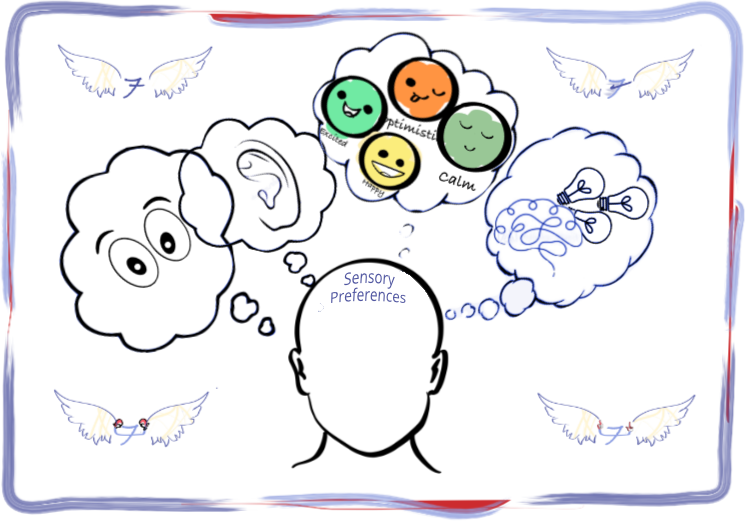
The following are generalisations on the characteristics of people who prefer seeing, hearing, feeling or thinking. Remember, with all generalisations, there are always exceptions.

Seeing
- Use visualisation for memory and decision-making – often getting insights about something.
- They may be more imaginative and have difficulty putting their ideas into words.
- Speak faster than the general population. Because they have a picture(s) in their mind, and if it is a moving picture, there is much to tell in so little time!
- Prefer in-person interactions – to see the other person and their reactions. Want to see or be shown concepts, ideas or how something is done.
- Want to see the big picture?
- You may not remember what people have said and become confused if you give them too many verbal instructions. However, if you can draw a map or picture for them, then they can see what you are saying.
- Remember faces more easily than names.
Hearing

- Be distracted by visual activity and less so by noise.
- Be more aware of subtle changes in the tone of your voice and be more responsive to certain tones of voice.
- Perceive and represent sequences and are able to remember directions or instructions more easily.
- Learn by listening and asking questions.
- Enjoy discussions and prefer communicating through spoken language rather than the written word.
- Talk through problems and like to have someone available to serve as a sounding board for their ideas.
- Need to be heard.
- Be easily distracted by noise.

Feeling
- Speak slower than the general population. Why? Because they need time to get in touch with how they feel about the topic.
- Be more sensitive to their bodies and feelings and respond to physical rewards and touching.
- Learn by doing, moving or touching.
- They dress and groom themselves more for comfort than how they look. Make decisions based on their feelings.
- Stand closer to other people than those with a visual preference – to feel the other person’s energy. In contrast, the person with a visual preference will stand back to see more of the other person (body language, etc.).
Thinking

- They need to make sense of the world, figure things out, and understand.
- Talk to themselves and carry on conversations with you in their mind. They often say they remember discussing something with you when you did not have the conversation. They did, however, in their mind!
- Learn by working things out in their mind.
- Not to be spontaneous, as they like to think things through.
- Logic, as do facts and figures, plays a vital role in the decision process.
- Memorise by steps, procedures, and sequences.