

(Low-to-mid Identity Quotient, IDQ)
You’ve met your Alter Ego. Here’s the theory underneath the fun. The findings below come from the Theory of Identity and Edited Reality, the ideas that Part 1 of The 7 Skills to impress™ is built on, told there through real stories rather than diagrams. Here is what your IDQ score is telling you.
A score in the 8 to 13 range is a Low-to-mid IDQ. You’re capable and switched on, and you function well day to day. It helps to be aware that your Identity reads pressure as a threat first, so your attention locks onto what might go wrong, and that vigilance can tip into worry that the people around you feel too. Here’s how it looks across the Identity Model.
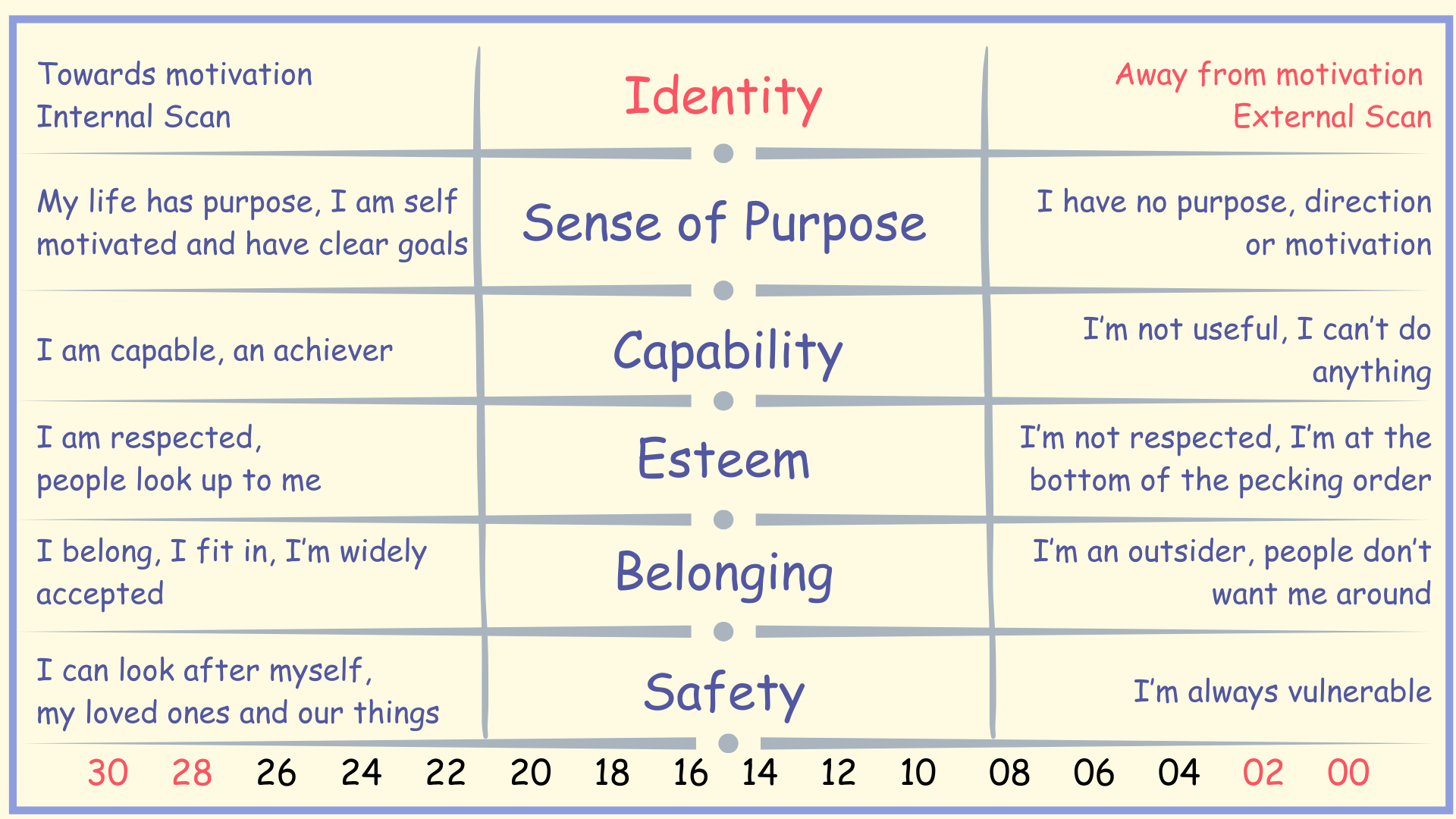
Safety is the base the rest is built on. You’re alert and you spot risks early, which is a genuine asset in the right setting. The cost is that the radar rarely switches off, so problems can feel more numerous and more likely than they really are, and that keeps you from chances worth taking.
You value the people around you and you want things to go well for the group. Under pressure, though, you tend to assume you’re not as valued as you are, so you brace for being overlooked. That bracing can read as distance, when really you care a great deal.
You hold yourself to a high standard, which is part of why you’re reliable. The difficulty is that a setback or a sharp word gets taken as a comment on you, so it stings more than it should and lingers longer than it deserves.
You have real skill, and others tend to see it more clearly than you do. When a challenge arrives, you expect it to go wrong, so you over-prepare for trouble and the task feels heavier than it needs to. The same care that makes you thorough can also talk you out of things you’d handle well.
You want to do work that matters and you’ve plenty to offer. When stress rises, the focus on what might fail can crowd out the sense of what you’re building, so purpose gets harder to feel even though the desire is there.
You pay close attention to how others are reading a situation, which makes you perceptive. The flip side is that you can put more weight on the worried reading than the situation warrants, and lose a little trust in your own judgement.
Your instinct is often to guard against a problem rather than address it, because the risks stand out more clearly than the opportunities. That protective stance heads off some real risks. It can also keep you circling an issue rather than dealing with it, which can slow your progress over time.
We all pass our state of mind to the people near us, all the time, through our words and manner. This is your Explanatory Style.
The way you explain the world to yourself rarely stays inside your own head. Teams pick it up. Families pick it up. Children especially. If your attention naturally focuses on what might go wrong, people around you can start to see the world through the same lens.
As your IDQ rises, this is often one of the first things to change.
Overall, a Low-to-mid IDQ means a sharp, careful mind that’s working hard to keep you safe, sometimes harder than the moment calls for. That vigilance has real value. The aim isn’t to lose it, it’s to stop it running the show, so your genuine capability gets to lead.
What to do next
Your score suggests there’s a gap between how able you are and how much of that ability the pressure lets you use. That gap is closable. Imagine what changes when the careful radar becomes a tool you switch on by choice, rather than the lens you see everything through.
The 7 Skills to impress™ is the toolkit built for exactly that. The Skills make you the person people want to talk to, and they give you the words that move people, usable anywhere and any time. Part 1 of the book uncovers how your IDQ develops and how it shapes your life.
It’s free, and we think you’ll find it genuinely useful. Part 1 opens with Three Seconds to Save a Life: Jacqui’s Story.