

(Low Identity Quotient, IDQ)
You’ve met your Alter Ego. Now here’s what sits underneath it. The findings below come from the Theory of Identity and Edited Reality, the ideas at the heart of Part 1 of The 7 Skills to impress™. In the book they’re told through real stories and people you’ll recognise. Here is the short version of what your IDQ score is pointing to.
A score in the 0 to 7 range is a Low IDQ. That doesn’t mean you lack ability. It means your Identity, the picture you hold of yourself under pressure, has learned to expect the worst before the evidence is in, and to step back early to stay safe. Here’s how that plays out across the Identity Model.
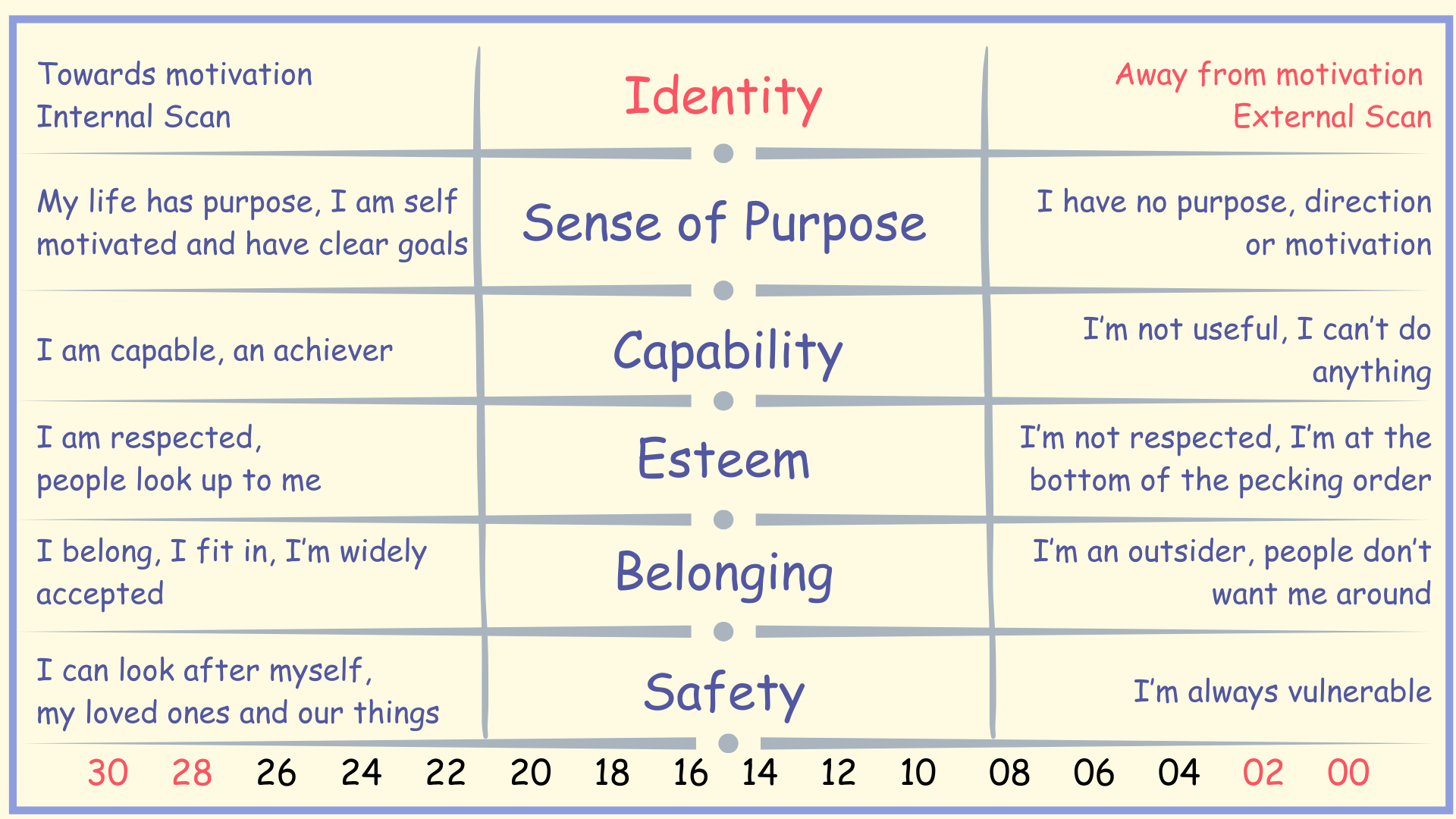
Safety is the foundation of everything else. When you feel secure, you look up and out. A Low IDQ keeps the radar fixed on what might go wrong, so threats feel close and constant, and the safest-seeming move is often to withdraw.
That caution is a form of self-protection, and it makes sense. The cost is that it can pull you out of situations before they’ve had a chance to go right.
You care about the people around you, and that matters more than it might feel right now. The difficulty is that you tend to assume rejection is inevitable, so you hold back before anyone’s had the chance to welcome you. Stepping away feels safer, and it reduces the connections you make with people in your work and private life.
You feel things deeply, which is not a weakness. The trouble is that you see a setback as if it’s proof of something negative about you, rather than a passing event, so even small knocks hit hard and linger.
You very likely have more in you than you’d ever claim. When a challenge arrives, though, the belief to meet it isn’t there, so the problem feels overwhelming and a way out looks like the only sensible option. That pattern keeps real ability hidden, from others and from yourself.
You care, often more than the people around you realise. When confidence is this low it becomes hard to feel that you’ve something worth contributing, and harder still to picture what you’d aim for. A Sense of Purpose tends to follow a belief that you can make a difference, and that idea is almost foreign to you.
You take others seriously, which makes you thoughtful company. The flip side is that you lean heavily on what others think and assume their verdict is the true one, which makes your own view hard to trust and stick with.
Under pressure the instinct is to move away from a problem rather than towards it, because the confidence that a solution exists isn’t there yet. Avoiding the discomfort brings relief. The problem is that the challenge is still there, and backing away too soon means you never discover what you were capable of.
We all broadcast our state of mind to the people around us, all the time, through our words and our manner. This is your Explanatory Style. A Low IDQ passes on its worry and quiet resignation without meaning to, and when those people are your children, they absorb the outlook too.
This part doesn’t stay inside your own head. The way you explain events influences the people around you too, and it often changes noticeably as your IDQ rises.
Taken together, a Low IDQ can make life feel more difficult than it needs to be, and the instinct is to protect yourself by expecting little. The part most people miss is this: none of it is fixed. The way your Identity reads pressure is learned, which means it can be relearned.
What to do next
Your score suggests there’s a real gap between what you’re capable of and how things feel when the pressure is on. That gap is closable. Imagine the difference when a setback stops feeling like a statement about who you are, and a challenge stops feeling like something to escape.
The 7 Skills to impress™ is the toolkit built to do exactly that. The Skills help you become the person people want to talk to, and they give you the words that move people. They work anywhere, with anyone. Part 1 of the book uncovers how your IDQ develops, how it quietly runs the show, and how to shift it.
It’s free to read, and we think you’ll find it genuinely useful. Part 1 opens with Three Seconds to Save a Life: Jacqui’s Story.
A note for very low scores (0–2)
A score right at the bottom, in the 0 to 2 range, can reflect more than a tough patch. Sometimes it points to a genuinely low state of mind that’s worth taking seriously. Please have a careful read of the list below, and if several of these feel true for you at the moment, it’s worth talking to someone.
- Feeling sad, tearful or empty much of the time
- Losing your temper or feeling irritable over small things
- Losing interest in things you normally enjoy, including hobbies, sport or sex
- Sleeping badly, or sleeping far more than usual
- Feeling tired and low on energy, so even small tasks take real effort
- Eating much less than usual, or far more
- Constant worry
- Thinking, speaking or moving more slowly than usual
- Feelings of failure or guilt, or dwelling on past mistakes
- Finding it hard to think clearly, focus or remember things
- Thoughts about death or about ending your life
- Worrying a lot about your health, or about aches and pains
There’s no shame in any of this, and you’re far from alone in feeling it. If this list rings true, please talk to your GP, or to someone you trust.
And if things feel urgent, contact the Samaritans free on 116 123. If you are in the United States, call or text 988 for immediate support. Both services are free, confidential and available day or night.
When you’re ready, the rest of this page and the book will still be here. Your IDQ can change, and so can how things feel.