

Stops and Shots: The LeBron James Approach to Impossible Goals
One NBA playoff game. One football team in crisis. One shift in attention that turned both around.
The Miami Heat were down in the third quarter of Game 2 of the 2012 Eastern Conference Playoffs. LeBron James was having a poor game by his own standards. The Knicks were ahead, the crowd was loud, and the numbers were not going the right way.
Then, in the fourth quarter, he scored seventeen points. His team pulled back into control, won the game, and eventually the series. After the final whistle, ESPN asked him what had changed.
His answer was short:
“We got stops, and we made a couple of shots. We just continued to fight.”
That was it. No mention of the scoreline they had faced, no reflection on the pressure of the moment, no acknowledgement of the star power on the other side. His mind had stayed on two small things that were still within reach, and, as it turned out, that was the whole point.
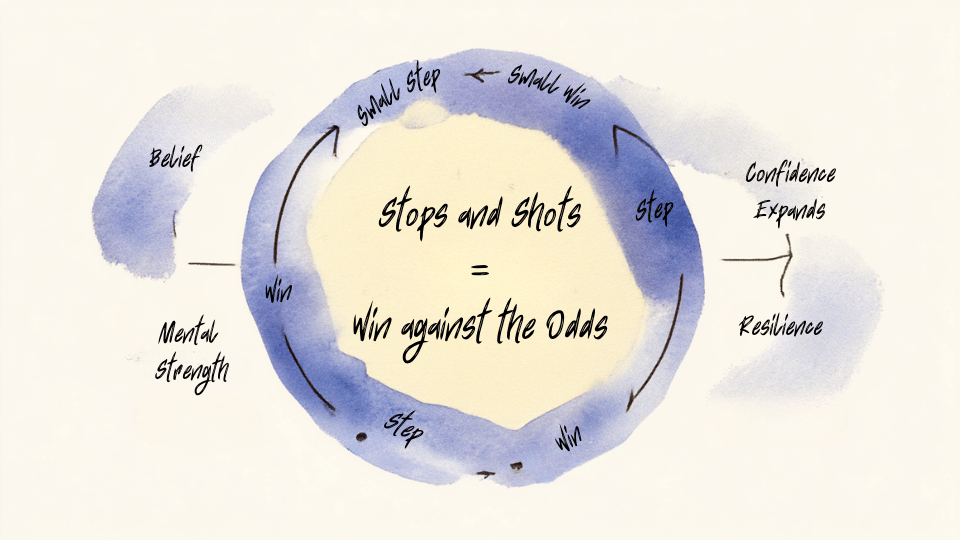
I got a call from Roy, the sports director of a football team I will call Rovers FC, about seven games into their season. Their goal was clear enough: win the league. The coach measured progress in blocks of seven games, and the expectation was fourteen points from twenty-one. They had seven.
It was early in the season, but the players already felt it had been lost. The top of the table looked far off, and without a clear route back up, their belief had started to slip. What had looked like a genuine ambition in pre-season was beginning to sound like wishful thinking.
Roy was keen to say they still cared. That was not in question. What had changed was how they were beginning to see the season. The Outcome had become too distant to feel realistic, and now they were focused on damage limitation.
What is easy to miss in these situations is that the problem is not a lack of effort or desire. It is where Attention Direction has gone.
When a goal feels distant or fixed, attention drifts toward everything that might go wrong rather than what can still be done. The challenge starts to feel Lasting, as though it will always be this way and nothing they do will shift it. The goal becomes a source of weight rather than direction.
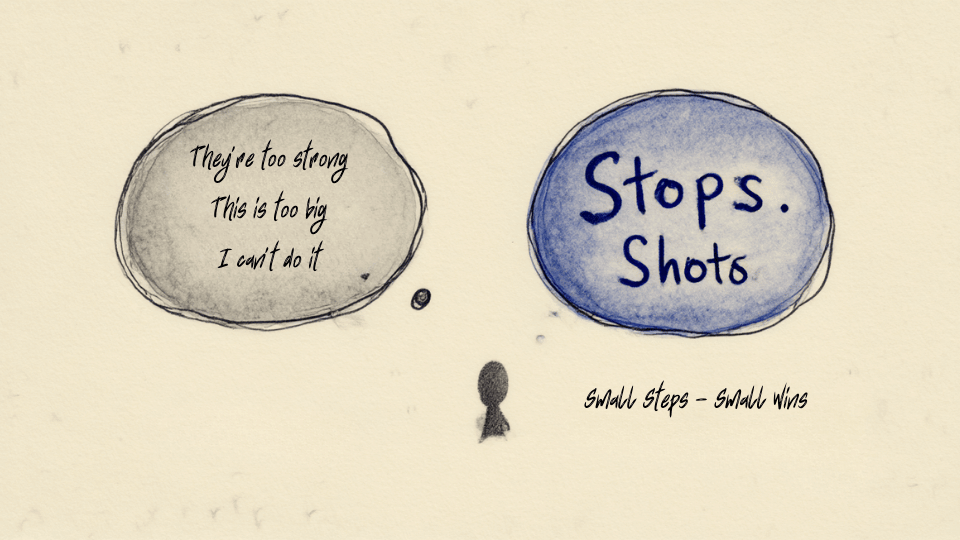
That was why I kept thinking about LeBron’s answer to the ESPN reporter.
What struck me was not just what he said, but also what he left out. He never framed the challenge by its size. He never described what was at stake, or how difficult the position was.
There was no sign that he had spent any energy weighing the pressure of the moment against his own Capability. He did not locate the problem in the quality of the opposition or the circumstances working against him.
Instead, his Attention Direction had narrowed to two things: Stops and Shots. Defensive stands and scoring chances. Both were immediate. Both were achievable. Both were entirely within his own influence, firmly in the territory of Self.
There is something in that which is easy to underestimate. When a problem starts to feel large, most people try to manage the feeling of it. They talk themselves into belief, or they remind themselves of past successes, or they try to suppress the worry.
LeBron seemed to do none of that. He simply redirected his attention to the next action that could be taken, and then the one after that, and stayed there. This is Outcome thinking at its clearest.
The mountain did not shrink. He just stopped looking at the top of it.
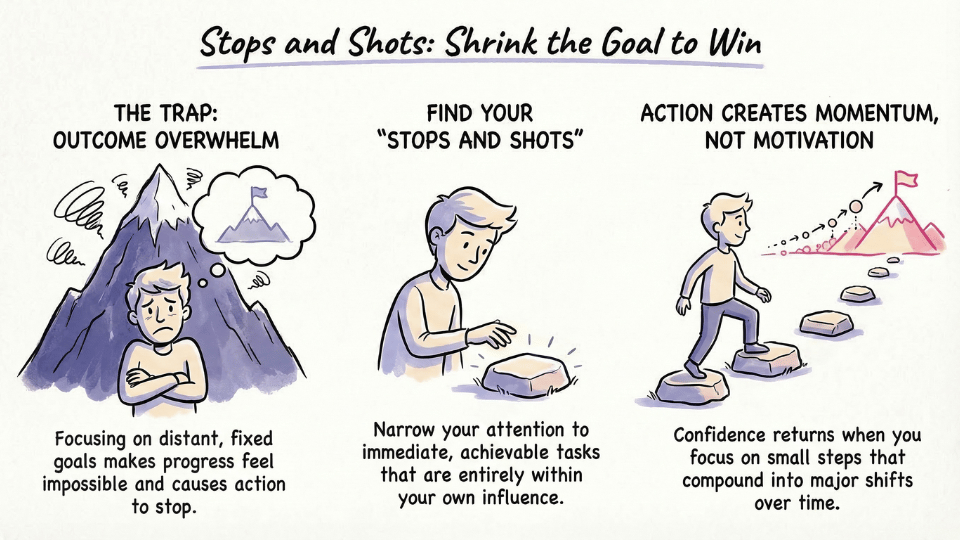
When Roy called about Rovers, the situation was different, but the underlying problem was the same. So we worked on finding their version of Stops and Shots Outcomes. Three things emerged.
The first was the way they spoke to one another after mistakes. They had become quite hard on themselves, and the effect was that the players tightened up. Every error felt heavier than it needed to because of the harsh criticism that followed it.
They agreed to keep the talk positive, shifting what they focused on when things went wrong.
The second was defensive. Too many players had been going to ground, trying to make that one big tackle, or block that changed the game. But, they ended up giving the opposition openings instead.
Staying on their feet became a clear Outcome. It was not glamorous, but it was something they could actually do, and it kept them in a position to influence what happened next.
The third was about recovery. One mistake had been leading to another, and then to a goal conceded, because attention had stayed on the error too long. They committed to resetting quickly after a mistake and avoiding a repeat. The mistake still happened. It just did not become a pattern.
None of these were complicated. They were chosen because they were achievable and because they shifted Attention Direction away from the league table and onto the next concrete step.
The season’s goals stopped feeling impossible and optimism grew one match at a time. The problem stopped feeling like something out of their control and started feeling like something they could deal with.
Their Identity as a team, which had been fracturing under the weight of those early results, grew, and with it their resilience.
Three months later, Rovers had gone unbeaten through that stretch and climbed from near the bottom of the table to within three places of the top.
The points gap that had felt so discouraging in those early weeks had narrowed significantly, and the way the players were experiencing the situation had shifted completely.
That shift turned out to matter more than anyone had expected. This is the Elevate Formula at work: refocusing attention onto the small steps that accumulate into a big difference.
There is a version of this that most people recognise when they think about it honestly. At some point, something has felt too big to act on. Not because you lacked the ability, but because Attention Direction had fixed itself on the whole thing rather than a small, achievable step.
What Rovers discovered, and what LeBron seemed to understand instinctively, is that the feeling of overwhelm is almost always a signal about where attention is pointing rather than a verdict on what is possible.
When focus settles on something small and reachable, momentum tends to build. The IDQ of the team, their collective sense of what they were capable of, recovered not through motivation or inspiration but through action. Small steps, taken consistently, began to compound.
The challenge does not have to feel manageable to make progress on it. You just have to find your Stops and Shots Outcomes.
How inspiring is your natural Explanatory Style when pressure rises? To find out, try the IDQ Snapshot, it takes less than three minutes.
This post is drawn from the wider 7 Skills to impress™ book, where I explore how confidence, capability and composure are built from the inside out.
Start reading the book here.


