How to be Successful at Anything and Everything
A study into the secrets of Jensen Huang’s incredible success.
In 2016, Jensen Huang sat across from his board of directors and asked them to bet the company, and he meant it literally. NVIDIA would abandon its existing roadmap, redirect its engineering towards a market that did not yet properly exist, and spend billions doing it.
The bet was really about install base. NVIDIA put CUDA into developers’ hands before the world knew what it was for. When AI suddenly needed that kind of computing power, CUDA was already everywhere.
(I’ve added plain-English notes on the italicised terms, like CUDA, at the end of the post.)
What gives someone the nerve to risk the future of a successful company, and to do it with such evident calm?
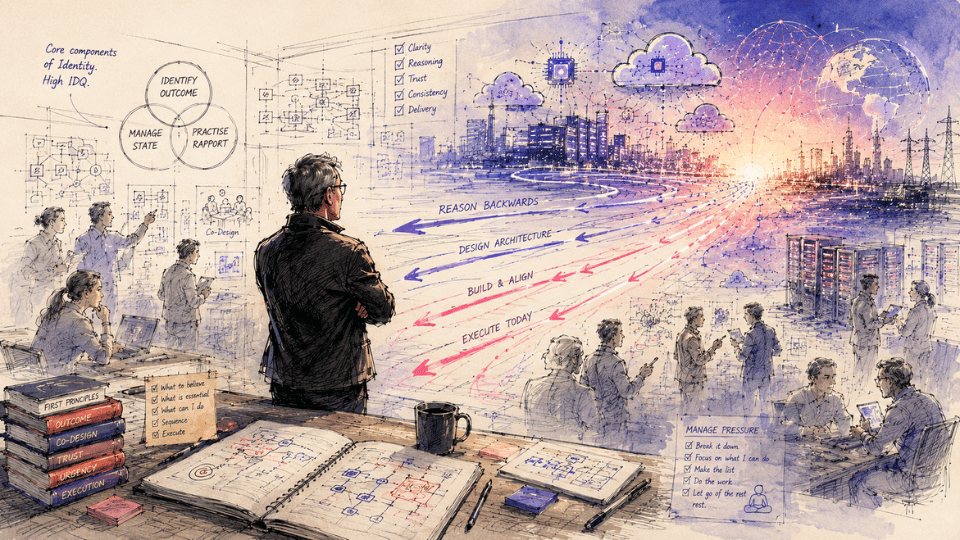
I have spent a lot of time with the Jensen Huang interviews: Lex Fridman, Acquired, Stanford GSB, Sequoia, Dwarkesh Patel. In the 7 Skills to impress™ framework, the patterns he reveals are core components of Identity. Jensen Huang gives us a rare chance to see high IDQ in action.
The Outcome comes first, always
Jensen describes his relationship with the future very plainly.
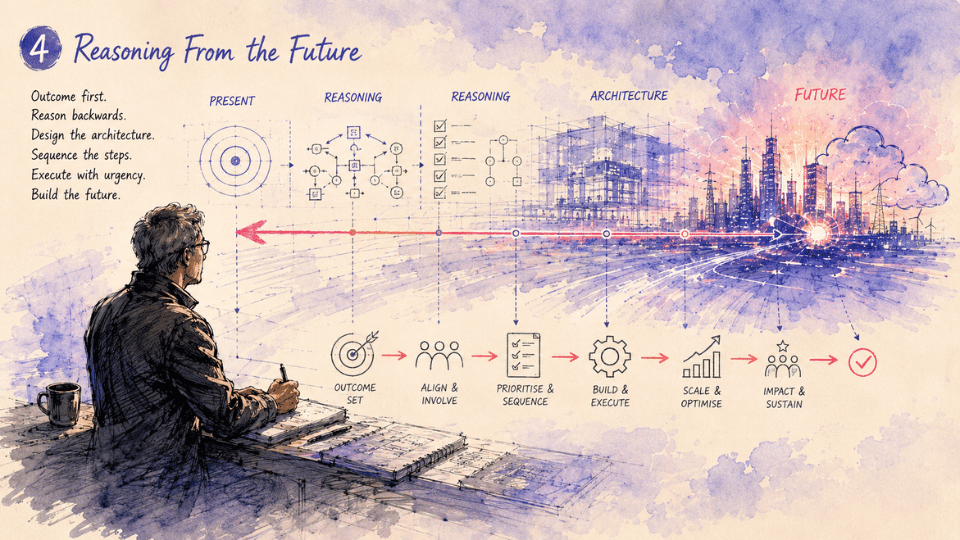
“I never look forward from where I am,”
he told the Stanford GSB audience.
“I go forward in time and look backwards.”
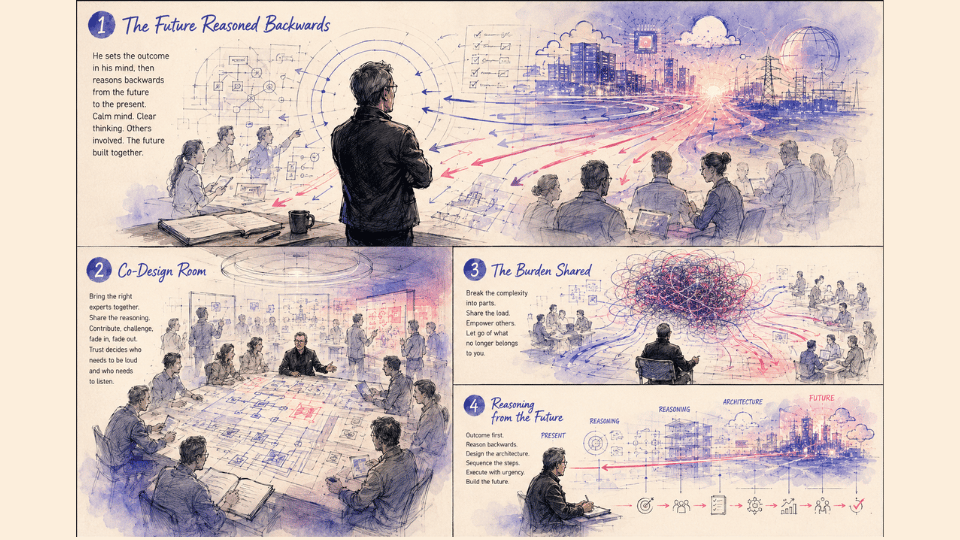
He commits to an Outcome, a clear picture of what will be true, and then reasons his way back to the present. The question he asks himself is:
“what has to be true between now and the result I have already decided on?”
In the Lex Fridman interview, Jensen explains that NVIDIA wanted to become a computing company rather than simply a graphics company.
Once that Outcome was clear, everything else followed: FP32, CUDA, developer trust, parallel computing and AI infrastructure.
That Outcome focus applies to the company itself. Jensen says:
“When you design a company, the first question is: what do you want the company to produce?”
Most organisational charts show hierarchy. Jensen is asking a more useful question. What is this company here to make happen?
The architecture of the company should reflect the Outcome it exists to produce.
That is why NVIDIA operates through what he describes as extreme co-design. Jensen brings experts together around the problem, lets them hear the same reasoning, and trusts them to contribute where their knowledge is needed.
That is a deliberate style of leadership from Jensen. He does not have to be the deepest technical expert in the room. His skill is bringing knowledge together and directing it towards an Outcome.
Jensen’s people bring depth. He brings direction, reasoning, integration and trust.
The Lex Fridman conversation makes one thing even clearer: for Jensen, an Outcome becomes real in his mind before it becomes real in the world. He says:
“At some point, there’s a reasoning system that convinces me so clearly this outcome will happen. That this will happen.”
Once that reasoning process completes, the Outcome becomes settled in his mind. What remains is sequencing.
This is how central Outcomes appear to be in Jensen’s mind. They are the organising force behind how he thinks, leads and builds.
He almost never seems to enter a serious conversation without an Outcome sitting underneath it. The question worth asking yourself is whether you do, and whether every meeting, every working day, every important conversation begins with a clear answer to the question:
“What am I here to make happen?”

High performance is installed before it is announced
One of the most striking things about Jensen is that he leads by reasoning in public.
He talks constantly with employees, suppliers, boards, developers, and industry partners about discoveries, insights, trends, and possibilities that interest him. He seeds ideas widely and repeatedly.
By the time he makes his recommendation, people have often become completely familiar with the idea. And when he delivers his recommendation, their response becomes:
“What took you so long?”
That is long-term belief shaping.
NVIDIA’s GTC conferences perform this function at industry scale. Jensen is announcing products, and he is also shaping the direction of the whole ecosystem: developers, suppliers, researchers, customers, investors. He introduces ways of seeing the future before the future fully arrives.
This is Leadership Rapport at a very high level.
He brings people into his reasoning process. He lets them see what he sees. He gives them time to understand it, question it, and make it their own.
Trust sits right at the centre of this.
He builds trust through clarity, consistency and reasoning, and he receives trust back because people have seen those qualities proved over time.
And underneath this is another important pattern: urgency.
“When you act with urgency,” he says, “everybody else acts with urgency.”
Tempo spreads. Calm spreads too. Leaders transmit emotional pace into systems.
Internal Reference and the courage to differ
When people told Jensen that NVIDIA could never become a billion-dollar company, then later a twenty-five-billion-dollar company, he did not accept their ceiling. As I write, NVIDIA is worth around $5.23 trillion.
His explanation is revealing. He believed people were failing to reason from first principles.
“My simulated output of the future is still gonna happen,”
he told Lex.
“And if it’s still gonna happen, I’m still gonna go after it.”
That is Towards language. Forward-facing. Destination locked.
It also reveals a very strong Internal Reference. Jensen listens carefully, takes expert input seriously, and once his reasoning process completes, he becomes extremely decisive.
You can hear this in his language. When discussing NVIDIA’s install base, he repeatedly says things like:
“I’m in every cloud company.” “I’m in every country.”
He merges personally with NVIDIA’s position in the world. The conviction is internal rather than externally referenced.
Difference thinking appears everywhere too.
NVIDIA’s early reasoning around CUDA partly came from observing something many engineers disliked: technically superior systems can lose to systems that are more available, more supported, and more trusted.
That insight became one of the foundations of CUDA’s success.
At one point he says the single biggest advantage NVIDIA has today is its install base. Developers trust that if they build on CUDA, NVIDIA will keep supporting and developing it.
Trust compounds.
It is worth pausing over your own defaults: whether your language moves Towards what you want or Away From what you fear, whether your reference point for a decision is Internal or External, and whether you are looking at what others in the room have missed or at what they have already noticed.
Staying calm is a learned skill
When Lex asked Jensen whether the pressure of depending on huge long-term supplier relationships ever weighs on him, his answer was immediate.
“No. Because I told them what I needed. They understood what I need. They told me what they’re gonna go do, and I believe them.”
I love this language because it captures Manage Your State perfectly.
He communicated clearly. He checked understanding. He received commitment. Then he trusted it.
He reasons pressure down into manageable parts.
Later in the interview, he explains the same process more directly.
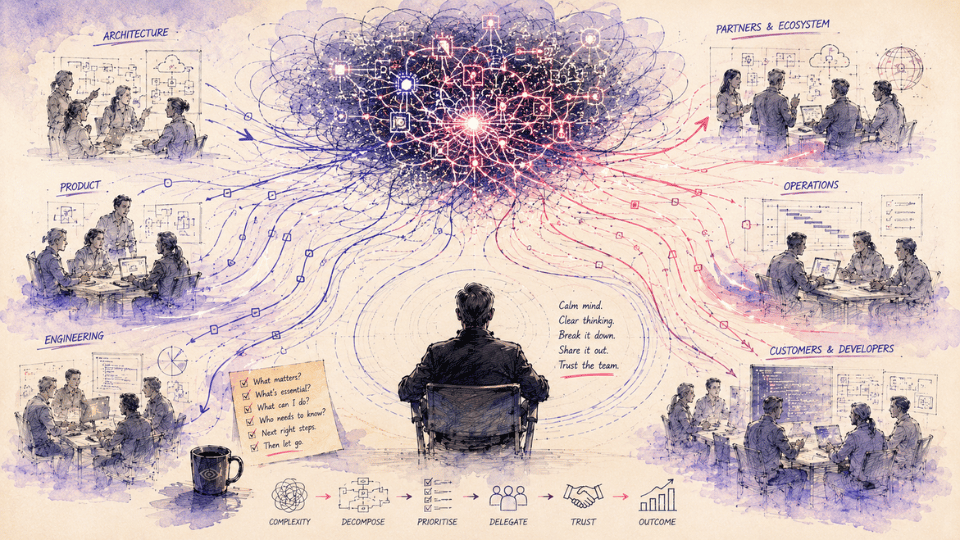
“I break things down so I don’t panic.”
That line is significant.
When something feels too big, he reduces it to the next pieces of work. He asks what can be done, who needs to know, what needs deciding, and what can be checked off.
Then he does everything he can, tells everyone who needs to know and makes those decisions.
“I can go to sleep because I’ve made the list of things that needed to be done.”
This is state management through reasoning.
During the dot-com collapse, NVIDIA lost around 80% of its market capitalisation. Jensen’s response was to return to fundamentals.
“What do you believe? What are the most important things? And just check them off.”
A checklist in a crisis is emotional regulation in practical form.
Another small phrase matters here, because he uses it with intent.
“How hard can it be?”
That is easy to misunderstand. He is not pretending the problem is easy. He is giving himself a way in.
“How hard can it be?” shrinks the emotional size of the task enough to begin.
He also talks openly about forgetting mistakes and setbacks.
“You need to know when to forget.”
That sentence explains a great deal about resilience.
Fresh-mindedness, forgetting setbacks, belief in yourself. These are deep strengths, rooted in Identity, transferable across situations, and stable enough to work under pressure.
That is one of the roots of endurance. When you are under pressure, it is worth asking whether you are seeing the problem as a specific thing to solve, or as a judgement about your worth. The meaning you make of it is what decides how much stress you feel.
Rapport built over decades
The most striking thing Jensen says about relationships is almost casual. After decades and hundreds of billions of dollars of business with TSMC, there is apparently no formal contract between them.
The relationship runs on trust built through repeated clarity, consistency and accuracy. Jensen describes flying into suppliers, reasoning from first principles, drawing diagrams, answering questions, and explaining why he believes something is going to happen before asking for multi-billion-dollar investment decisions.
That is Practice Rapport at elite level.
The Elevate Formula underneath all of it
Near the end of the Lex conversation, Jensen describes resilience directly.
“The ability to go into an experience fresh-minded, the ability to forget the setbacks, the ability to believe in yourself. This combination is really important for resilience.”
That is the Elevate Formula sitting underneath performance, because he is naming the Strengths, Qualities and Attributes that underpin his confidence, resilience and ability to inspire under pressure.
Jensen’s Stanford GSB comment about suffering gives this even more weight. He told the students, in effect, that he wished suffering upon them. He even said he wished his own children had suffered more, because people who suffer develop qualities that make them resilient and successful.
It was a shocking thing to say, and it made me sit up and take notice.
He is saying these qualities are forged. Fresh-mindedness, grit, courage, endurance, self-belief, and the ability to move on are built by going through hard things and practising how you respond.
What this means for you
The lesson from Jensen Huang is not that everyone should try to build the next NVIDIA. It is that the same internal patterns work at every level of pressure.
Identify Your Outcome is the simplest place to start. Before the next meeting, the next important conversation, the next working day, ask yourself one clean question:
“What am I here to make happen?”
Not the agenda. Not the subject. The Outcome. The specific thing you want to be true by the end of it.
Jensen appears to do this constantly. He walks into conversations with a destination already formed in his mind, then reasons backwards from it.
Manage Your State comes next. Jensen does not calm himself by pretending pressure is small. He breaks it down. What needs deciding? Who needs to know? What can be checked off? What is the next useful move? This makes pressure manageable.
Practice Rapport runs through the way he deals with people. He explains his reasoning. He brings people into the problem. He makes himself available for questions. He gives suppliers, employees, developers and partners enough clarity to trust the direction before he asks them to commit.
That is why trust compounds around him.
The Persuasion Pathways are there too. Jensen’s Internal Reference gives him strength and calm once his reasoning is complete. His Towards language keeps attention on the future he is building. He listens carefully, then decides from the inside out.
The Elevate Formula explains why suffering matters in his story. Hard experience gives you the raw material for SQAs: grit, courage, endurance, resilience, self-belief, fresh-mindedness.
Those SQAs then strengthen Internal Reference. You begin to trust yourself because you have evidence. You have been through difficult things, noticed how you responded, and banked the qualities that helped you keep going.
So the practical message is simple. Have an Outcome. Break pressure down into action. Build trust by fully engaging and explaining your reasoning. Notice whether your attention is moving Towards what you want. And when things get hard, look for the SQAs being built in you.
That is the deeper pattern behind Jensen Huang’s success: a trained way of thinking, deciding, relating and recovering under pressure.
These posts pair very well with:
Plain-English notes for non-technical readers
CUDA
CUDA is NVIDIA’s software platform that lets developers use its chips for far more than graphics. It’s significant because once developers had learned it, trusted it and built with it, NVIDIA became much harder to replace.
Install base
Install base means the number of people, companies and systems already using a technology. In this case, the more developers who built with CUDA, the more valuable and familiar NVIDIA’s platform became.
FP32
FP32 is a standard used for high-precision computing. In simple terms, it helped NVIDIA’s chips become useful for serious scientific, engineering and computing work, rather than just fast graphics.
Parallel computing
Parallel computing means breaking a large task into many smaller tasks and doing them at the same time. That is one reason GPUs became so important for AI.
GPU
A GPU is a specialist chip originally designed to handle graphics. Over time, GPUs became valuable because they can process many tasks at once, which makes them well suited to AI.
TSMC
TSMC is the Taiwanese company that manufactures many of the world’s most advanced chips. NVIDIA designs its chips, but TSMC is the specialist manufacturing partner that can actually make them at the scale and precision required.
Want to read more?
I write about confidence, pressure, performance and the hidden patterns that shape how people think, act and lead.