

This article explains how to supercharge kids’ SQAs with the “Elevate Formula”. A framework that transforms challenges into openings for growth.
As parents, it’s natural to want to shield children from hardship. Yet with care, we can use them to bolster their belief in themselves.
Nurturing their EF mindset gives children unshakable confidence in themselves, empowering them to thrive in adversity. Equipped with this outlook, they will bounce back from life’s tests stronger and wiser.
Thread 4 is a Simple, Powerful Building Block for A High IDQ.
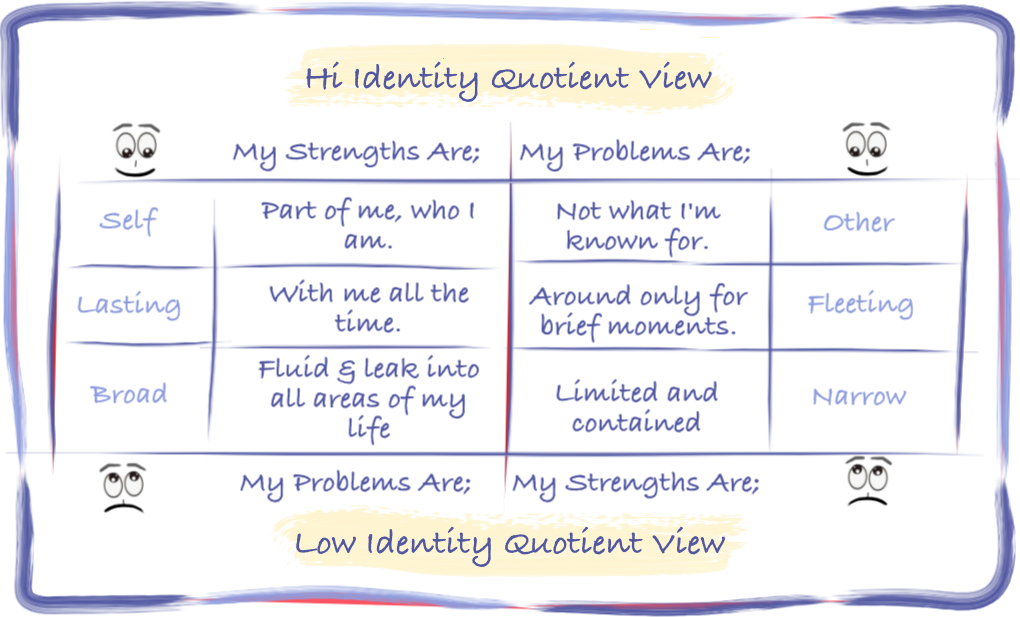
The diagram above is a reminder of the features of The Elevate Formula. This version looks at how it relates to Identity.
People with high Esteem (looking from the top down) believe their strengths are Self, Broad, and Lasting. They see problems as Other, Narrow and Fleeting. The reverse is true from the low self-esteem position (looking from the bottom up).
Thread 4 is about helping our children develop this ‘top-down’ mindset
And it’s pretty simple to do this;
- You will use the SQAs you’re already revealing in your child.
- And now, you’ll begin to show how they work in a range of situations.
First, show your children that their SQAs are “Broad”
Broad
For example, let’s take the three SQAs we saw Sam develop in Thread Three;
- Fast learner
- Determined
- Makes friends easily
Now, please glance through the list of challenges below. Note each one for which those SQAs would help someone remain confident and perform at their best.

For example, being determined could help Sam cope and perform when faced with the following;
- Fear of the unknown/dark etc.
- Injections or going to the dentist.
- Bullying.
- Tests or exams.
- Sports events.
To name but a few!
Link your child’s growing list of SQAs to more events…
So, as we look through that list of common fears for children, we can see that each strength could work with many challenges.
When your children fully embrace the broad and wide-ranging scope of their SQAs, accepting them as “Self” and “Lasting” comes naturally. Let me explain.
For example, maybe you see your child do, two or three of the following actions;
- Pick themselves up when a team they play for, or support, loses
- Staying calm when they lose a board game instead of getting upset.
- Apply themselves to some boring homework.
- Dealing with disappointment calmly when a planned event is cancelled.
- Refraining from interruptions when parents are on an important phone call.
- Patiently waiting their turn when playing group games with friends.
That’s two, three or more occasions, you can give feedback that your child is good at controlling their emotions. (Priceless preparation for tough times in their lives).
And as you do, you seed the idea that this strength is ‘Broad’. I.e. it works in every area of their life.
Gently Enhance The SQA List
So now you can gently enhance the work you began in Thread 3. Show that the list of strengths you’re forming with your child is ‘Broad’.
After a while, your child’s confidence will be fuelled by a cluster of ‘Broad’ SQAs. They may not be consciously aware, but their growing list of qualities will become a mental suit of armour for them.


Self
And after a while, these attributes come to define them in their own mind. They adopt them as a part of their self-image.
For example, Sam came to think of himself as a determined person who learns quickly and can make friends anywhere.
And so, naturally, these strengths formed part of how he saw himself. They were part of a growing list of SQAs that boosted his self-image, aka Identity. I.e., they were now ‘Self’.
Lasting
As he began to see and think of himself this way, he knew he had these strengths to help him whenever he faced a challenge. They had become a permanent part of his makeup. I.e. they were now ‘Lasting’.
This Identity gives Sam confidence in trying times. He believes he has the SQAs to cope with any challenge, setback, or problem. He feels capable and resilient.
“Now, apply the other side (‘The Problem is…’ side) of the Elevate Formula to challenges.”
We want children to view problems as;
- Other: Not linked to their Identity.
- Narrow: contained to the issue at hand.
- Fleeting: Having a shelf life.
If you take another look at the Elevate Formula diagram, you’ll see what this means.
Your child is already in the High IDQ position, looking down on the left side – strengths side – of the box. Now you guide them to take on the right – the problem side – as well.
We’ll return to Sam’s story for an example.
The spur for Sam’s parents to work on building his High IDQ came from an incident at school…
… some classmates teased him about being a single-parent family.
He came home very upset one day. He told his mom he was a “reject” and had “lost all his friends”. He thought that no one would ever want to be his friend again.
Sam’s Edited Reality Was On The Wrong Side Of The Elevate Formula

Sam’s stress was much worse because he framed the problem on the wrong side of the Elevate Formula. In our diagram above, that would be from the bottom looking up. I.e.;
- Self: He now thought of himself as a ‘reject’. He’s adopted this defect as part of his Identity. And so, he’s made his personal qualities the cause of the problem.
- Broad: In his mind, Sam hadn’t just lost the friends that teased him – he felt everyone saw him as a ‘reject’. Which meant he thought his other friends wouldn’t like him either.
- Lasting: Sam couldn’t see this problem ending. Being a ‘reject’ felt permanent to him. And so he thought his old friends would never like him again.
Anywhere you are, you’ll find a knife to fit your wound.
It’s a marker of a Low IDQ to switch the Elevate Formula in this way. It’s more stressful because you feel as if you’re to blame.
Even worse, that feeling will never go away. Because you believe a flaw in your makeup is the cause of your problems. So you carry the root of your troubles around like an open wound.
And so, you will always feel that pain. And anywhere you are, it will afflict you. You’ll find a knife to fit your wound.
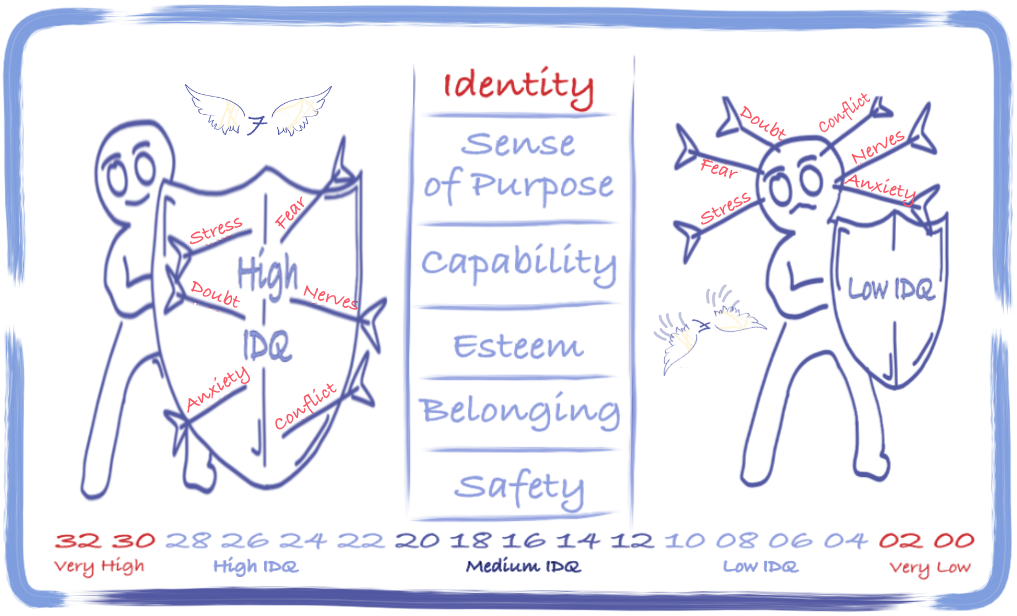
See How It All Changes On The High IDQ Side
Other: Taking a setback in your stride is easier if you feel good about yourself. This means you believe you’re “OK” and not the wellspring from which issues flow.
Narrow: You can better cope when you can cordon off the challenge and contain it where it arises. Fencing in the issue in limits its effects to that part of your life. Elsewhere, you remain untouched.
Fleeting: It is much more wearing when you sense that a problem stretches into the foreseeable future. But you will feel more confident if you know it will be all over at some point.
This is just the tonic we need in tough times.
So we’ll use this insight to continue building your child’s High IDQ. Which means they will have less stress in their lives. And they can be at their best when the chips are down.
When your child faces a testing event, we can subtly draw out features to switch their framing of the Elevate Formula to the High IDQ way around.
For example;
Other
- Focus on where the issue came from. Highlight how your child’s Identity is separate from the source of the problem.
- Discuss how their SQAs will help your child deal with the situation.
- Mention how valuable and admirable those SQAs are.
- After the event, ask how their SQAs helped deal with the issue.
Narrow
- Talk about how any stress they feel comes from and is limited to the event.
- Discuss other areas of their lives where this problem isn’t present.
- Comment on how good it is to isolate issues. To stop them from leaking into every other part of their lives. Make this ‘talent’ one of their SQAs.
Fleeting
- Ask them to imagine the crisis is over and discuss how they will feel.
- Chat about how their SQAs will help bring it to a close. Afterwards, check out how they helped.
- Invite them to reflect on what most pleased them about how they dealt with it.
Note: Rapport is needed for this.
Sam Sees The Bully Boys For What They Are.

When the ‘reject’ bullying started, Uma could tell Sam was upset when he got home. She had been worried about him for a while, and her stomach churned seeing him this way.
But Uma held back from jumping in to help. She let Sam mope for a bit, then tried reflecting on what she saw.
“You look down, Sam?
He simply replied, “Yeah.
Uma said, So I see. She said nothing more and waited.
This took a lot of self-control from Uma. She wanted to throw her arms around him and ask what was wrong. She longed to tell him that he shouldn’t listen to the bullies and that he was loved.
Patience Wins The Day Again!
But she knew that he would close down if she did. So she waited.
After a moment, he told her about the “reject” comment and that he’d lost all his friends. Uma listened. She didn’t comment, explain or try to correct him.
She asked questions that got him talking and helped her see the world through his eyes.
Soon he was pouring his heart out. Uma encouraged him to get it off his chest by listening, umming and ahhing. She waited until he’d got nothing left to say. He’d got it all out there.
Now he was ready to have his mind changed!
Other
Uma talked about the boy at the centre of the name-calling. And through chitchat, got Sam to see;
- How he’d been mean to other kids over the past few weeks. In fact, he was always being mean to someone.
- There was nothing wrong with the kids he picked on. It was all about his mean nature.
- Maybe this kid had issues. Perhaps he needed help.
Narrow
- He’d played football during games, and the team was as friendly as usual. Because the bully boy didn’t play and wasn’t around.
- Then he realised it only happened when the bully boy was around.
Fleeting
She asked Sam what things would be like when the bully boy got bored with calling him a reject and latched onto someone else.
This was a clever ‘Assumption’, of course. She got him to talk at length using her Rapport skills.
After this talk, Sam was a little more settled. So Uma asked him how his strengths (Determined, Fast Learner, Making friends quickly) would help him at school tomorrow.
Uma Reshapes Sam’s Edited Reality
It didn’t matter what he said, just that he answered confidently. Because if he answered the question, he would have accepted the Assumption that his SQAs would make tomorrow at school better.
And Sam did answer. Just a few ideas, but that was enough. Uma’s response was perfect.
She was well into her own R&P journey. And this experience gave her a deep understanding of what she was doing with Sam and how to approach the task.
She told Sam that she could see how difficult things at school were ‘at the moment’.
She added that he would need his strengths and to draw heavily upon them. And she asked him to tell her, when he got home, how they had helped.
In those short sentences;
- She implied the experience was temporary.
- Implicitly acknowledged it was hard for him.
- That he had the SQAs to cope.
- Urged him to focus on them and try hard to deal with the problem.
- She finished with the Assumption that Sam’s SQAs would make a difference.
Now Sam’s Edited Reality had been entirely reshaped by Uma. Although still a little uncertain, he looked forward to the next day with a positive spirit.
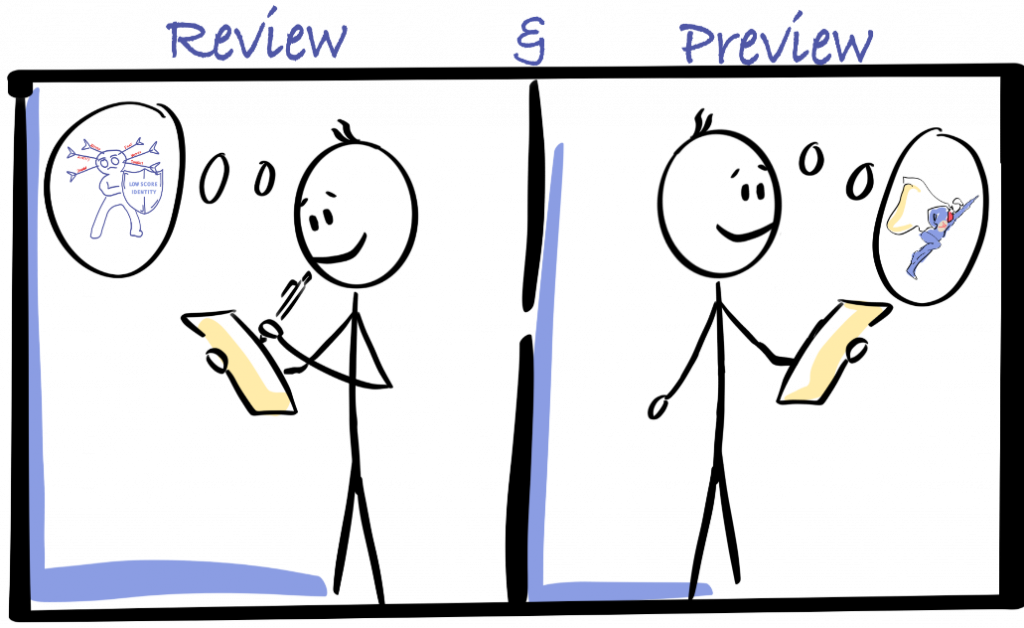
When he came home after school the next day, Uma did ‘Review’ with him…
And it had been tough for Sam, but he didn’t get too stressed this time. Now he felt that he was OK and the bully boy was not. It was Bully Boys’ problem, not his (Other).
He didn’t carry the emotions into the better parts of his day (Narrow). He said it helped to know this wouldn’t last forever (Fleeting). Uma and Sam agreed that he could add ‘courage’ to his list of SQAs.
Uma didn’t talk to Sam’s Form Teacher about this until it was over for him. She wanted him to deal with it himself. She wanted him to ‘Use The Difficulty’ to grow his confidence and self-belief.
Sam was beginning to add the complete Elevate Formula mindset to power his growing list of SQAs. His bulletproof Identity was being built on solid foundations.
Up Next: Coach Your Child To Steer Their Own Course
In Thread 5, you’ll learn how to correct behaviour and build confidence at the same time. Learn a breakthrough approach that rejects the ‘carrot and stick’ and builds an inner compass instead.
Discover how our theme, “use the difficulty”, teaches kids behaviours that bring them success. Radically improve classroom focus and attitude. Nurture lifelong independence, self-control, and mental fortitude.
Transform conduct and character – click now to unlock your child’s potential from the inside out!
Thread 5: Coach Your Child To Steer Their Own Course