

Inner Compass vs. Carrot and Stick
Thread Five looks at how to respond when our children don’t behave well.
We’ll look at how common carrot-and-stick responses damage self-esteem. And I invite you to see the ‘problem’ as another opening to build a High IDQ.
Because with the Elevate Formula, we tackle bad behaviour and build a High IDQ at the same time. And we do this by working with the idea of an ‘inner compass’.
What It Is The Inner Compass And Why It Matters
Experience, beliefs, values, strengths, and qualities form your inner compass. It’s buried deep inside the ancient part of your brain. It becomes your instinct in trying moments.
We want our children to develop so they face a challenging world with confidence and peace of mind. To do this, we use the 7 Skills to help them develop a High IDQ.
An inner compass is a vital part of a High IDQ. To explain what I mean, consider this.
Everyday life throws up tests and trials all the time…
And when we face them, a voice deep inside us asks, “am I good enough, am I right or wrong, am I respected, do I belong, am I safe?” etc.
When this happens, suppose our instinct is to look inside ourselves for the answers? To scan internally and use this compass for direction.
In that case, our experience, strengths and beliefs become our guiding stars. And our doubters or critics have less influence. We are more sure of ourselves.
The opposite is “External Scan” which you can see at the top right Low IDQ side of the model.

Externally focused people don’t have the innate strength that comes from an inner compass…
Instead, they seek the opinions of others. This puts them at the mercy of the views, moods, whims and impulses of the people around them.
If they argue with a loved one or friend or stumble before a challenge, it’s a calamity. A negative comment from someone can wound them. A problem at work/school follows them home. They need constant reassurance.
And that’s because these events all confirm the inner limiting Identity Beliefs that fuel a Low IDQ.
And suppose they haven’t internalised a robust set of SQAs. In that case, they constantly need feedback to tell them they are safe, wanted, worthy and respected.
This is why externals are unsure and changeable. Their inner strengths, beliefs and values take second place. They feel more stress and are less resilient.
In Stressful Times, An Inner Compass Is Priceless

We want our children to develop an inner compass to guide them through challenging times…
Internally focused people are assured and constant. They are led by their inner compass and are not easily knocked off course.
Because, from this source, flows the confidence to make good decisions and follow them through. And to gain the peace of mind that comes from believing in themselves.
Carrot and Stick Creates External Focus
The most common approaches to correcting bad behaviour involve some form of carrot and stick. This places the verdict on those questions – “Am I good enough etc.”, in the hands of others.
This pushes children to look outward. They are learning that what people think of them decides whether they will get the carrot or the stick! And so, the opinions of others start to matter more than their own.
That’s why carrot and stick approaches subdue a child’s inner compass and nudge them toward external focus and a Low IDQ.
Our work with The 7 Skills is about building this inner compass as part of a High IDQ…
And that’s what we’re going to look at now. A way to deal with our children when they play up that supports our work coaching a High IDQ.
The 7 Skills and the Elevate Formula are perfect for this job. So is our theme, “Use the Difficulty”.

The Unruly Classroom
I was invited to work with a school in the North of England. In a few of their classes, they had some complex behaviour issues. One or two children in some classes were so disruptive that they took up nearly all of the teacher’s time.
Some students drifted through the halls like sailboats with no rudder, directionless and pushed only by the winds of another’s attention.
Identity and Behaviour Issues
The children weren’t ‘bad’. Some just craved attention and found it by playing up.
Others had no clear Identity or a sense of purpose to guide them. They flitted from moment to moment, dotty, foolish and absent.
Some felt their cheek, and mischief made them admired and wanted by their classmates. It became their Identity.
Talking with the teachers, these few children caused so many problems that they dragged the whole class down. It was a low-achieving and stressful climate to work in. The school was curious about how the 7 Skills could help them.
The 7 Skills Provide Self-Esteem and Purpose
I was confident that the 7 Skills would help. I was sure that Identity was both at the heart of the problem and the solution.
We could find a way for them to fulfil their Identity needs through good behaviour. I.e., doing the right things is a way for them to find safety, belonging, and esteem.

And in this way, we’d nurture their inner compass
The children would behave because they wanted to. Not because they were told to, or because they were after a reward or trying to avoid punishment.
The plan was to use The Elevate Formula to achieve the following Outcomes;
- To describe all bad behaviour as Other, Fleeting and Narrow.
- To nurture the children’s belief in a growing list of SQAs.
- To define these SQAs as Self, Lasting and Broad.
- For these SQAs to hatch an Identity fit for a happy and successful school life.
And with this simple approach, we changed the behaviour of these trying kids in just weeks. The teachers were delighted with the turnaround.
Their stress dropped, and they began to enjoy teaching again. And now they could teach the whole classroom. And with their growing IDQ and attention in class, these kids suddenly had a much brighter future!
Here’s our strategy.
Teachers Build Their Foundation
As you may have guessed, I started the teachers off with IMP, the first three of the 7 Skills to impress. Identify your Outcome, Manage Your State and Practice Rapport.
These three pillars of strength gave them the base they needed to stay the course and succeed.
The teachers also decided to do Review and Preview. Their struggles in this class had been stressful and knocked their confidence. R&P fixed this and gave them an insight into what they were working to achieve with the kids.
Now they were ready. And if you are a parent or teacher reading this, I strongly suggest you build the same base for your work.
Changing Behaviour with The Elevate Formula
Case Study: John, 8 years old.
John enjoyed drama and maths and was a good student in those lessons.
In all other subjects, he was out of hand. John would talk during quiet times, interrupt, leave his seat and steal things from other children’s desks.
He didn’t respond to his teachers’ requests to behave.
John’s Form Teacher – Emily – organised a joint approach from staff across all his lessons. Each week this team selected strengths from this list.
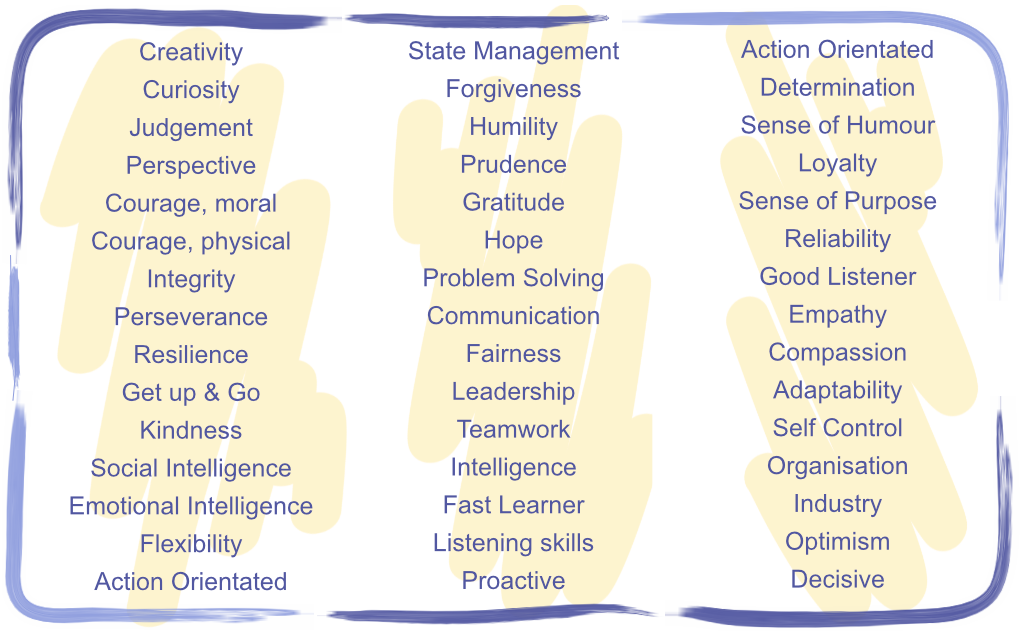
Good Behaviour is Self, Lasting and Broad
They chose the SQAs they felt the staff could credibly link to John when he behaved well. They started with ‘fast learner’ and ‘self-control’ on my advice. In the first week, they also added ‘hard worker’.
Staff would give John feedback on one of these SQAs at every opportunity. At first, they could only do this in Maths and Drama because his behaviour in other classes was so bad.
One Week In – Rapport and Showcase
At the end of the first week, Emily took him aside for a chat. She built Rapport by talking about the play he was rehearsing in drama. He loved talking about this and was soon relaxed and chatting freely.
Once she was happy, she had Rapport with John, his teacher said,
I’ve been hearing about what a good week you’ve had, John. And I’ve seen this too. A few teachers have said what a fast learner you are. They’ve been telling me about your self-control and how hard you work.
John agreed and said that he’d had a lot of good feedback. He was clearly happy with this. Emily asked him questions about when he’d shown these qualities, how they’d helped him and what he felt about them.
John Proofs His Own SQAs
As John explained what these SQAs had done for him, they became more than a bunch of nice words from his teachers. His association with them went deeper, and he began to own them.
In John’s mind, they were ‘Broad and Lasting’’ too, because they had been mentioned more than once across two classes.
So now he began to see them as part of who he was, Self, i.e., part of his Identity.
Emily Carefully Boosts John’s Internal Focus
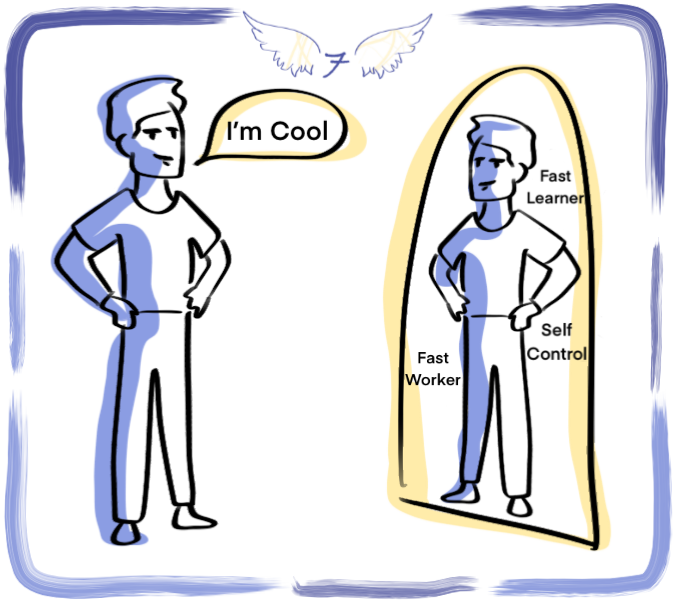
Emily noted that in their chat, he often said, “It was cool”. She seized on this as a label for his Identity at this stage. She said,
Those qualities are cool, John, and it must feel very cool for you to have those qualities
Note she didn’t say;
With those qualities John, everyone will think you’re very cool.
The second passage would have encouraged John to think about how he was viewed by others, i.e. an External focus.
Emily’s words in the first passage were designed to boost John’s Internal focus. She wanted him to believe inside he was cool and had no need to worry what others thought.
In this way, she was making his internal motivation stronger than the need for feedback and assurance from others. Emily was cultivating John’s inner compass.
Each week, they selected just one more SQA to work on as a team…

They felt this was a natural and manageable way to move forward. They wanted steady and authentic progress. They needed to build on a good start and didn’t want to risk John’s gains by pushing too hard and fast.
Of course, they reinforced the already established SQAs when the chance arose. And his list was slowly building, as was his High IDQ and inner compass.
They all realised his old behaviours would pop up again at some point. And so the teachers were ready for when John started to misbehave. We had prepared two tactics for these moments.
Tactic 1: The Quick Response
They framed his poor behaviour as Other, Fleeting and Narrow for minor issues.
For example, when he was struggling with an essay in English, John began to talk out loud and interrupt the teacher. His teacher said to him;
I’m surprised you’re interrupting me, John. That’s not like you. That’s not cool at all.
The teacher went on;
I know you’re a fast learner, and you are good at hard work and self-control. When you’re acting like your usual self, It’ll be good to see the progress you can make in your essay.
In this simple language, John’s teacher had implied that his poor behaviour was unusual. I.e. that it was Other. He had made the point that this behaviour no longer defined John.
John connected with the idea that his misbehaviour was a momentary lapse. I.e. it was Fleeting and Narrow behaviour.
And the teacher had brought up a few of the ‘Lasting’ SQAs the staff had been working with. These comments are all linked to his new Identity of ‘Cool’. This new Identity now fulfilled John’s needs from the Identity model.
I.e. he felt safe and secure. He was wanted and respected. And, vitally, he believed he was a hard worker and a quick learner, and he wanted to be ‘cool’. This allowed John to move on quickly. He got back to work.
Tactic 2: The Separated Response
Tactic 1 worked really well on many occasions. But the time came when John carried on playing up.
The school had its own discipline procedure, and this was used. The system started with John being sent out of the classroom for a few minutes.
The threat was that he would have to see the Head Teacher if he didn’t calm down. John knew that if that meeting didn’t go well, he could face exclusion for a limited period.
Happily, he quickly calmed down and was allowed to return to the classroom.
I had already discussed with the teachers how Rapport would be hard to create after a higher-level intervention. And so, they decided to separate the punishment from the 7 Skills work. This became Tactic 2.
Sometimes Rapport Needs A Cooling Down Period
The staff found it helpful to allow a cooling down period. Then come back later to talk through the event, sometimes waiting until the next day before using the Elevate Formula.
They would build Rapport and then describe the ‘event’ as Other, Fleeting and Narrow. His SQAs as Self, Lasting and Broad.
For example, after an event where he caused an argument and was sent out of class, the teacher waited until the following morning. Then he said to John;
We saw the old John pop up for a moment yesterday, didn’t we? I’m glad we’re back to normal now. I wonder how you’ll stay on track and be the cool John we all enjoy having around? Do you think your strengths like self-control, being a hard worker, and being a good friend will help you?
If you have a good Rapport, questions like this work well. When the ‘client’ answers, they accept the sentence’s critical message (or Assumption).
I.e. in this case, John bought the idea that his SQAs would help him “stay on track…”.
John’s Transformation

After six weeks, the staff were using about eight SQAs with John. They often used Tactic 1 Quick Responses to good effect. Tactic 2 Separate Responses were needed just a couple of times.
Ideally, they would have liked to involve his parents in the project. Sadly, that was not possible in John’s case.
This project included six of the most time-consuming children in the school. Sometimes the Form Teacher would engage parents/carers. There was great teamwork in the staffroom and charts on the wall to coordinate the SQAs.
These children’s prospects picked up big time. They now had an emerging High IDQ and an inner compass that would guide them for life. This job wasn’t over, but the Teachers had seen enough to engage them for the long term.
The results transformed not only classrooms, but the whole school also benefitted
And the teacher’s job became much more fulfilling. It’s also pretty good for job satisfaction and a school’s reputation!
This Project is For All Children
I believe this Outcome should be shared with all the children in a school. Sure, it’s good to tackle the most disruptive children first.
But building an inner compass and a High IDQ is a gift that serves those kids for life. So all should benefit from the approach.
And, if you’re a parent reading this, the same goes for your children. This Thread gives you some ideas to deal with poor behaviour that fits Threads 1 – 4 and our mission to build bulletproof Identity.
It’s a gift for life, and I can’t think of a greater kindness you can do for your children.
Five Threads To Weave A Child’s Potential
Now you’ve learned the unique 7 Skills to impress™ toolkit to nurture your child’s highest potential. Apply all 5 threads continuously to unlock their confident, happy and healthy future. Let this tool kit empower you to cultivate their flourishing High IDQ. Begin your journey today!