
Part 1

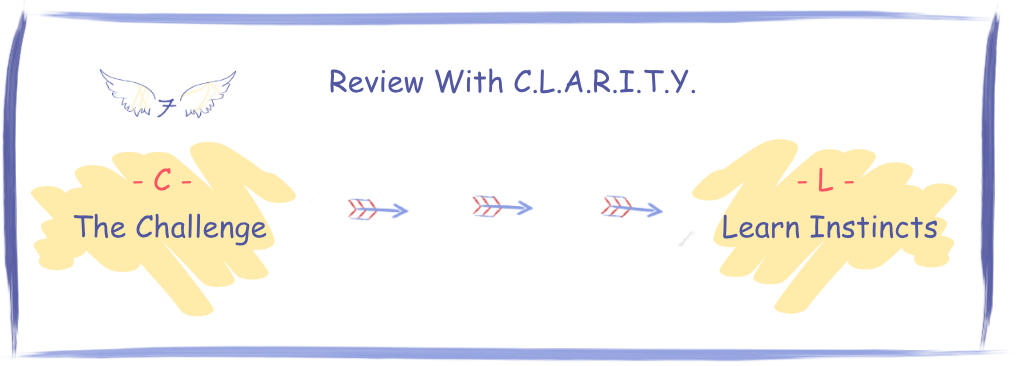
Here’s what you must carefully note in your diary for the Review stage. It starts with looking at the challenge, focusing on seven steps known as CLARITY Let’s dive in!
Review – Seven Steps Known As CLARITY;
Part 1
C – The challenge.
L – Learn Instincts.
A – Assess Identity Beliefs.
R – Root Causes.
I – Interrupt and Breathe.
Part 2
T – Traits (SQAs).
Y – Your Identity.
1. Focus On A Past Challenge
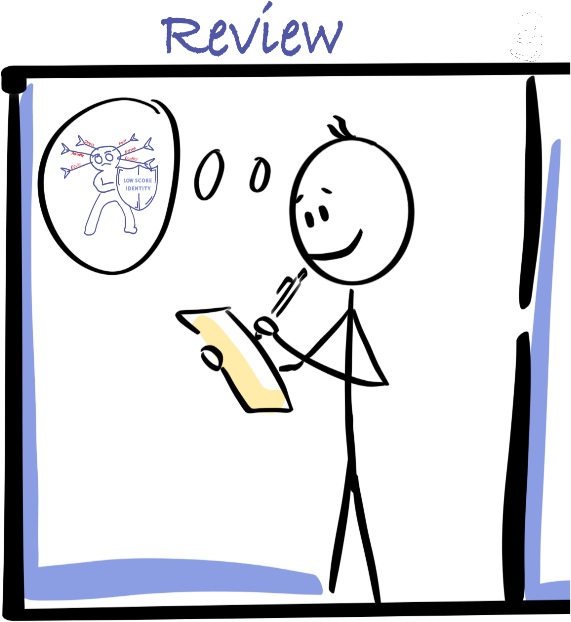
Please think of a challenge or stressful situation you’ve dealt with recently. You’re going to “use the difficulty” for Review.
These challenges can be anything from big problems, average disappointments to everyday niggles. Little or large, they all work. And don’t underestimate how much progress you’ll make with the more minor issues.
Everyday challenges work well, particularly as you get started with R&P. I noticed how my clients found it harder to see their strengths in the big challenges that life threw their way.
The stress of these moments overshadowed their thinking, and they found it hard to feel good about themselves.
They found it easier to be clear about their performance and qualities with less stressful routine challenges, and where they felt they had done well. And since R&P will be a routine drill that you run regularly, everyday challenges will feature prominently.
Once you have Reviewed a few of your common issues, you’ll appreciate what you can draw from each situation, significant or minor, with CLARITY
2. Learn Your Instinctive Reactions To A Challenge
When you Review a past challenge, carefully note the impression the challenge had on you. What was your reaction, how did it affect your thinking, behaviour or performance?
- Focus on your emotions and thoughts.
- Did it change your mood? Did you become anxious or get butterflies?
- Did you feel a thumping heartbeat? Some people feel hot, others get queasy or trembling fingers, arms etc.
- There may be milder signs for more common stresses. Such as anxiety, nerves, self-doubt, dithering and so on.
- And what was the end result? Did you feel embarrassed or angry, were your talents and abilities restricted?
- Did it go all the way and trigger FFF?
Once you have done this a few times, you will see similarities in your stress response across a range of issues. Think about how it starts. What are the first signs of this reaction happening?
By closely watching your emotions and thoughts in these moments, you’ll gain a rare insight into the workings of your System 1 mind. Something that usually goes unnoticed. This awareness grants you control.
With focus and practice, you’ll start to catch your knee-jerk reactions as they arise. Allowing you to respond with poise rather than impulse. You gain the power to choose your reaction instead of being owned by habitual emotions and thoughts.
As you look inward during difficulty, you understand your own mind better. With time and commitment, you’ll know just what to do to stay calm and in control, no matter the challenges.
3. Asses Identity Beliefs/Reflex Thoughts

Your response to adversity is led by your Identity and Identity Beliefs. The stress moment is the trigger, and then your System 1 kicks in using your IBs around Safety, Belonging, Esteem and Capability to sift and sort and create your Edited Reality.
So these IBs guide your reactions. If they’re uplifting (IDQ score 22 – 32), you’ll remain confident and your SQAs will be given wings. If they are limiting IBs (IDQ score 10 – 0), you’ll feel nervous and shackled.
And from our IBs stream the thoughts and words that tumble into our heads or out of our mouths. It’s the very first instinctive words that reflect our Identity Beliefs. (You may remember we discussed this in the 7 Skills book, under Identity Beliefs in chapter 5, How Identity Secretly Pulls Your Strings).
So, sort through the jumble of feelings that the challenge stimulates, and uncover the most potent ideas which ripple out from your Identity. Those first spontaneous thoughts or words that come into your head or pop out of your mouth. What are the ones that are the most instinctive and relevant to your state of mind?

So, to surface your IBs, drill into these thoughts by asking yourself questions such as;
- “Why is this a problem for me?”
- “What’s important to me about this?”
- “What does this mean to me?”
- “Why am I worried about this?”
When you answer, drill down to a deeper meaning by asking further questions. Run this cycle a couple of times. It will take you closer to your IB.
E.g. an upcoming job interview was filling a client with nerves. So he ran this drill and asked himself, “Why is this a problem for me?”
Client: “I’m feeling so nervous about this job interview. Why is this a problem for me?”
Inner Voice: “Well, I don’t want to mess it up and ruin my chances.”
Client: “Okay, and what’s important to me about this?”
Inner Voice: “I need to make a good impression and prove that I’m capable.”
Client: “I see. And what does this mean to me?”
Inner Voice: “It means that if I fail this interview, it reflects on my worth and abilities.”
Client: “Why am I worried about that?”
Inner Voice: “Because deep down, I fear I’m not good enough..”
This final answer was a better idea of the Identity Belief that was the underlying cause of my client’s nerves.
You’re Going To Hear IBs Everywhere, All The Time
Once you begin to spot Identity Beliefs, you’ll hear them all around you, everywhere all the time. You’ll notice yourself saying them, as well as friends, family and colleagues. And you’ll note how for you, the same few keep popping up.
Note anytime you have a small accident. For example, if you knock something over or trip. What is the first thing that pops out of your mouth?
Or try thinking through one of the reflex thoughts, saying it to yourself and then end the sentence with “… because…”. And allow your System 1 to fill in the gaps.
For example, Ananya’s Reflex thought was, “I can’t do this?” So she took a couple of 7-11 breaths and then said to herself, “I can’t do this … because…”. Immediately, the phrase “I’m useless” popped into her head. And that turned out to be her most limiting Identity Belief.
Keep hunting out those Identity Beliefs. Once you begin to expose them, they become obvious to you.
4. Root Cause
Spot the Link Between Response and Identity Beliefs

Now that you have a good grasp of your Identity Beliefs, it’s a simple matter to figure out how they lead your reaction to pressure.
So focus on how your IBs trigger your thoughts, emotions and behaviour.
Remember, limiting IBs are wrong and outdated, developed by your System 1 as a child. What empowering beliefs can you substitute them with?
And the last step for Review (CLARITY PART 1) is…
5. Interrupt and Breathe
7-11 Breathing.
Now you’ve surfaced your process for reacting to stress or a challenge. You have a grasp of the IBs that your system 1 uses to “protect you” when confronted with a problem. And you can see how that IB triggers your emotional response to it.
Surfacing what the IB is and how it affects you is a big step. And just being aware can help you counter it.
Now you know your warning signs, as you build up to an unhealthy or limiting reaction to a challenge you can interrupt it with these two steps;
- Compose yourself and keep your System 2 switched on with 7-11 breathing.
- Deny the IB and break the cycle that leads to your SQAs being shackled. After all, the IB is wrong and out of date. What beliefs about yourself can you substitute them with? Think of something that’s a better fit, more suitable and empowering.
The Limiting Identity Belief is like an old piece of software that needs an upgrade. And, over time, upgrading it is what we’ll do with R&P. We’ll supplant those limiting IBs with ones that lift you and give your talents wings.
But first, to get back control, we’ll use 7-11 Breathing to interrupt the process that leads to an unhelpful, limiting, or even damaging reaction. “Interrupt and Breathe” is like switching off and switching on again.
Anytime you spot those warning signs that signal the start of your stress response, begin 7-11 Breathing and challenge those limiting Identity Beliefs.

The Review drill using CLARITY helps you understand and control your reactions to stress.
You learn your instinctive stress response by looking back at past challenges. Detecting reflex thoughts helps you reveal underlying beliefs and how they trigger stress and nerves.
You can halt knee-jerk reactions with 7-11 breathing.
Awareness and interruption are key. Review gives you an understanding of your reactions. Catching early stress signals lets you stay in control. With this insight, you can take back control and unlock your potential.
With a regular Review routine, you master stress and stay calm when things get tricky.
Up Next: Learn Your Superpowers: Review with Part 2 of CLARITY
With the last two letters of CLARITY – ‘TY’ – you’re going to discover Your Superpowers and unlock your secret talents.
You will learn how to:
- Spot your strengths that drive your capability.
- Build confidence from within.
- Stay calm and confident when challenges hit.
- Rewrite old Identity Beliefs into uplifting new ones to reshape your Identity.
Many unexpected insights into your deep subconscious await you. To begin;
Click Here for Review with Part 2 of CLARITY
Previous Chapter: Introduction