

“No two people see the external world in exactly the same way. To every separate person, a thing is what they think it is; in other words, not a thing, but a think.”
Penelope Fitzgerald
We like to believe we control our actions and reactions to events, but we may not be following our free will as much as we thought!
As we saw in earlier chapters, your Identity begins shaping itself early in life, creating shortcuts to keep you safe from danger, rejection, and failure. It develops patterns to manage stress, shortcuts to help you belong, and habits to avoid being humiliated.
But Why Does Identity Do This?
Because your subconscious is always running a hidden programme, a Theory of Control.
It’s constantly asking:
- How can I stay safe?
- How can I be accepted?
- How can I avoid embarrassment, pain, or loss?
The answers it finds are emotional, not logical. They take shape as beliefs – not about the world, but about you. These beliefs eventually become the rules of your internal operating system. And over time, they become secret rules that edit your reality and pull your strings.
For most of our waking lives, the following three areas of our behaviour are being controlled behind the scenes:
- Identity Beliefs,
- The Towards or Away From instinct,
- The Internal or External Reference
These beliefs are not neutral. They’re shortcuts designed to control how we behave and to control how others respond to us, to avoid being hurt, rejected, or embarrassed. They help us navigate the emotional risks of life. But as I’ll explain, they often become prisons we can’t see.
Identity Beliefs: The First Hidden String

You can see Identity Beliefs in the 7 Skills to impress™ Identity Model above – represented on the left and right of each layer. On the left, they are uplifting. On the right, they are limiting.
As children, by the age of 6, as we saw in Chapter 2, The Illusion of Reality, we developed a powerful skill: we learned to imagine what others were thinking about us. But, as we know, these are beliefs, not facts.
Identity Beliefs are born as strategies for emotional control. They are our subconscious way of thinking:
If I believe this about myself, maybe I can stay safe, wanted and respected.
These beliefs are based on emotionally charged events and imagined outcomes. They may not be accurate, but they feel like the truth. And so they become protected.
Over time, they harden into what Will Storr calls in his fabulous book, ‘The Science of Storytelling’, Sacred Flaws.
Tumbril’s Sacred Flaw: “I’m probably not good enough.”

Tumbril was a professional cricketer, a fast, left-arm bowler, a quality highly prized in the sport. But his coach told me he was on the verge of being ‘let go’.
When we first met, I built Rapport and listened. In the first 30 minutes, he said some version of the phrase “I’m probably not good enough” several times.
This wasn’t just insecurity. It was a verbal expression of Identity; his Theory of Control.
Tumbril had the potential to be a match-winner. But just as often, he was a match-loser. His pace was incredible, but he would lose control, give away runs, and spiral.
Our everyday language tends to hide the doubts we hold deep inside. But instinctive comments bubble out into the open under pressure or in unguarded moments.
They emerge from the deepest recesses of our minds. They contain the raw inner truths we usually conceal. The source of these comments was his Sacred Flaw.
He hallucinated disapproval. A blank look from a batsman became a signal of disrespect. A poor delivery became confirmation of his inadequacy. Even when others praised him, he couldn’t hear it. His Identity was editing his reality.
Tumbril wasn’t hearing what his teammates actually thought. He was imagining it.
He was filtering everything through his Capability Sacred Flaw: I’m not good enough.
We used the 7 Skills to impress™ approach to update his Theory of Control. Since he was already an expert at hallucinating rejection, I guided him to hallucinate something else: that everyone thought he was brilliant.

After just two sessions, he returned excited, saying his teammates were now talking about how he was “bowling rockets.” I smiled, because they always had.
He just hadn’t been able to hear it.
That subtle shift in Identity changed everything. When he bowled a poor ball, he no longer panicked. He saw it as Other, Narrow and Fleeting, not proof he was a failure. His Sacred Flaw was no longer running the show. His real talent was.
That season, he produced world-class figures. The following year, he signed with one of England’s biggest clubs. Not long after, he played for his national team, all from one small but powerful change: a new belief about himself.
Liam and the Lens of Stupidity

Sacred Flaws often reveal themselves in moments of shock or stress, if you know how and when to listen.
Take my friend Liam. He once stepped out into the road without looking. A car swerved and blared its horn. No harm done, but Liam was shaken.
The first words out of his mouth?
“Darn! I’m so stupid.”
This wasn’t just frustration. It was a window into his Theory of Control.
His Sacred Flaw wasn’t just a thought. It was a lens. He saw the world through it.
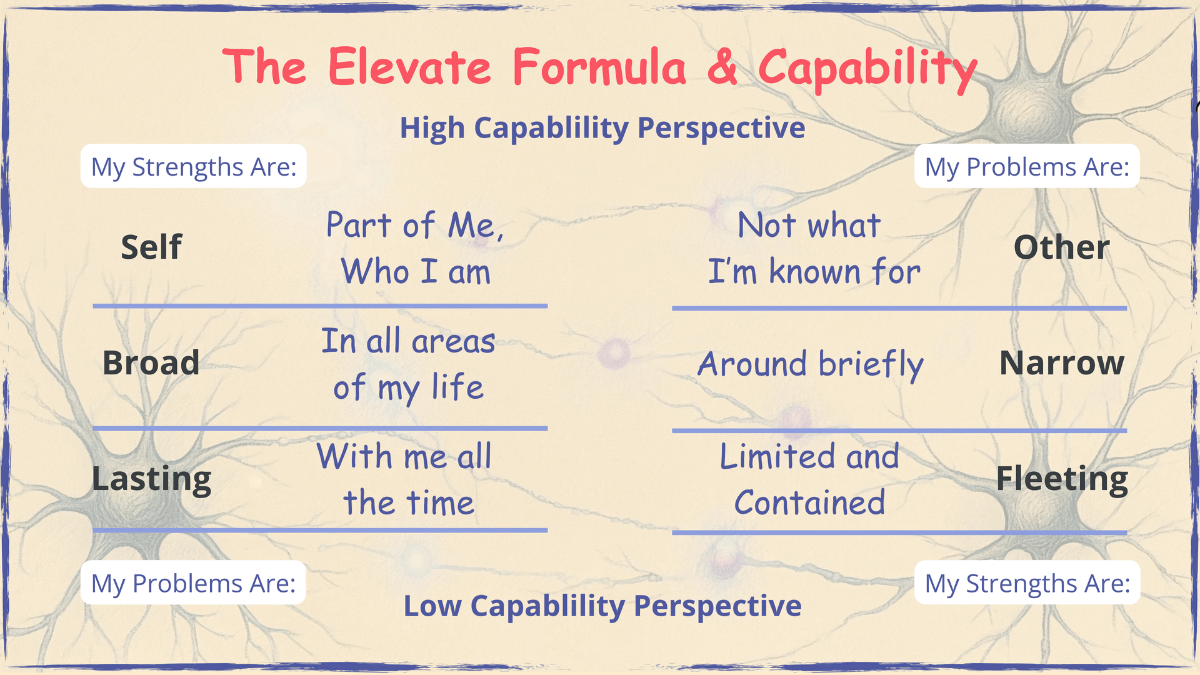
We know this is a belief that reflects a Low IDQ because of the Elevate Formula structure he uses to express this belief, i.e., “stupid” is Self, Broad and Lasting.
He saw mistakes as evidence that he was fundamentally flawed. He held back in meetings. He apologised before sharing ideas. He didn’t trust praise. He feared success because success invites scrutiny.
Like Tumbril, he wasn’t reacting to events. He was reacting to his Identity Belief, his internal rule for controlling life.
What Makes Sacred Flaws So Powerful?
- They feel true. They’re emotional, not rational.
- They shape perception. You only notice what confirms the belief.
- They filter feedback. Praise gets dismissed. Criticism becomes gospel.
- They become hidden rules for survival. They dictate how much of yourself you show, how much you try, and how much risk you’ll take.
But Sacred Flaws are just old strategies. And they can be rewritten.
The 7 Skills to impress™ model helps you recognise them, understand them, and change them.

Internal vs External: Another Theory of Control

High IDQ individuals have an internal reference system. When they face a challenge, they look inward. Their compass is built from their own qualities and values.
Low IDQs depend on feedback from others. If someone smiles, they feel safe. If someone frowns, they feel exposed; their sense of worth changes with the emotional weather.
This is another version of the Theory of Control:
If others approve of me, I’ll be OK. If they don’t, I won’t.
Towards vs Away From: Future Control in Action
High IDQs instinctively move towards goals. They seek opportunities, spot solutions, and act. Why? Because they believe they are capable, wanted, and safe.
Low IDQs are wired to move away from a threat. They scan for what could go wrong and try to avoid pain.
This, too, is a form of control:
If I avoid this risk, I can avoid feeling not good enough.
But that avoidance keeps them stuck. What was once a safety mechanism becomes a limitation.
As a result, ‘Towards’ people are more ‘go for it’ types and are generally more optimistic. ‘Away From’ can appear pessimistic.
In Part 2, Chapter 4, Reveal Persuasion Pathways, I explain how someone’s language contains cues that give away their internal/external bias and how we can use this to influence ethically.

The idea of the Theory of Control, and our Sacred Flaws as expressed by Identity Beliefs, Internal/External and Towards/Away From, complete the 7 Skills Identity model. It is a beautiful summary of how System 1 and Identity create our Edited Reality and pull our strings.
And, this fully explains the quote I opened with;
No two people see the external world in exactly the same way. To every separate person, a thing is what they think it is; in other words, not a thing, but a think.
PENELOPE FITZGERALD
What You’ve Just Learned and Why It Matters
In How Identity Secretly Pulls Your Strings, you uncovered the hidden levers that guide your every thought, feeling, and action, often without your awareness.
You now know how:
- Identity Beliefs begin as subconscious strategies, your mind’s attempt to control how others treat you, how you avoid pain, and how you stay safe.
- These beliefs can solidify into Sacred Flaws, limiting self-truths that feel so real, we protect them even when they hold us back.
- Whether you scan Internally or Externally affects your confidence, resilience, and emotional independence.
- Whether you move Towards rewards or Away From threats determines how you respond to challenge, pressure, and uncertainty.
This deeper layer of programming explains why:
- Tumbril couldn’t hear praise, because his Identity had decided it was dangerous to believe he was good enough.
- Liam’s Sacred Flaw shaped his whole outlook, not just in crisis, but in everyday life.
- Jacqui’s darkest moment wasn’t weakness; it was the crash of an Identity trying to protect her children and herself from forces she believed she could no longer control.
You’re not just reacting to the world.
You’re reacting to the version of the world your Identity creates.
The good news? Once you see the system, you can change it, which is where we’re going next.
What’s Coming Next and Why It’s Important
In Unleash Your Potential: The Power of IDQ, we bring everything together.
You’ll explore:
- That IDQ really is a measure of your emotional integrity across Safety, Belonging, Esteem, Capability, and Purpose
- How your IDQ shapes your Edited Reality, whether you see setbacks as threats or as opportunities
- The dramatic difference between living with a High IDQ or a Low IDQ, and how that affects your health, happiness, influence, and fulfilment
You’ll also discover why:
- Many people succeed with a Low IDQ but pay a heavy price.
- High IDQ empowers parents, teachers, coaches, and leaders to unlock potential in others, not just in themselves.
And most powerfully of all:
- You’ll see how the 7 Skills to impress™ were designed to help you shift from Low to High IDQ, naturally, ethically, and lastingly.
UP NEXT: CHAPTER 6: Unleash your Potential: The Power of IDQ
Previous Chapter
Index
Glossary of Terms
Further Reading:
Please also see the references for the last chapter.
Storr, W. (2019).
The Science of Storytelling: Why Stories Make Us Human and How to Tell Them Better. London: William Collins.
Storr introduces the Theory of Control as the emotional engine of all narrative: humans, like story characters, seek to master unpredictable worlds and restore a sense of order when it’s lost.
Pennebaker, J. W. (1997).
Writing about emotional experiences as a therapeutic process. Psychological Science, 8(3), 162–166.*
Shows that expressing emotion through writing enhances mental and physical health by improving self-regulation.
Lakoff, G. (1987).
Women, Fire, and Dangerous Things: What Categories Reveal about the Mind. Chicago, IL: University of Chicago Press.
Reveals how language and metaphor structure our thinking—why the words we use shape perception itself.
Giles, H., Coupland, N., & Coupland, J. (1991).
Accommodation theory: Communication, context, and consequence. In H. Giles, J. Coupland, & N. Coupland (Eds.), Contexts of Accommodation: Developments in Applied Linguistics and Social Psychology (pp. 1–68). Cambridge, UK: Cambridge University Press.
Explains how we subconsciously adapt our speech to mirror others, forming connection or asserting Identity.
Dweck, C. S. (2006).
Mindset: The New Psychology of Success. New York, NY: Random House.
Demonstrates how a growth mindset turns failure into feedback—core to reshaping identity beliefs.
Oaten, M., & Cheng, K. (2006).
Longitudinal gains in self-regulation from regular physical exercise. British Journal of Health Psychology, 11(4), 717–733.*
Finds that strengthening self-control in one area (exercise) boosts willpower across life domains.
Kross, E., Bruehlman-Senecal, E., Park, J., Burson, A., & Axelrod, J. (2014).
Self-talk as a regulatory mechanism: How you do it matters. Journal of Personality and Social Psychology, 106(2), 304–324.*
Shows that distanced self-talk (“you” vs “I”) increases emotional control and wiser reasoning.
Higgins, E. T. (1997).
Beyond pleasure and pain. American Psychologist, 52(12), 1280–1300.*
Introduces regulatory focus theory – our drive toward goals shaped by promotion (gain) or prevention (avoidance).
Pickett, C. L., & Brewer, M. B. (2001).
Motivation. In D. T. Gilbert, S. T. Fiske, & G. Lindzey (Eds.), Handbook of Social Psychology (4th ed., Vol. 2, pp. 531–595). New York, NY: McGraw-Hill.
Outlines social-motivational systems that drive belonging, influence, and identity maintenance.
Oettingen, G., & Gollwitzer, P. M. (2010).
Planning promotes goal striving. In E. T. Higgins & A. Kruglanski (Eds.), Handbook of Motivation Science (pp. 142–162). New York, NY: Guilford Press.
Shows how mental contrasting and implementation intentions bridge intention and action.
Nemeth, C. J., & Wachtler, J. (1983).
Creative problem solving as a result of minority influence. European Journal of Social Psychology, 13(1), 45–55.*
Demonstrates how dissenting voices improve group creativity and decision quality.
Brehm, J. W., & Brehm, S. S. (1981).
Psychological Reactance: A Theory of Freedom and Control. New York, NY: Academic Press.
Explains why people resist persuasion when they feel their freedom is threatened.
Baumeister, R. F., & Leary, M. R. (1995).
The need to belong: Desire for interpersonal attachments as a fundamental human motivation. Psychological Bulletin, 117(3), 497–529.*
Defines belongingness as a basic psychological need – central to Identity and well-being.