What his language reveals about staying confident and effective under pressure
There is a phrase Joe Rogan uses to describe himself that has stuck in my mind. He calls himself a professional learner. Three ordinary words, and something quietly remarkable in how they shape his behaviour when the world turns hostile.
I recalled the phrase a few years ago, when the pressure on his podcast reached a boiling point. Musicians were withdrawing their catalogues from Spotify. Advocacy groups were organising campaigns. Commentators argued that conversations on the show were irresponsible and should not be given that kind of reach. Spotify, having paid a reported $100 million for the rights, was being asked: Do you intend to keep standing behind him?
The pressure was real, sustained, and public. Yet, the podcast itself changed very little. Rogan kept doing what he had been doing for years: sitting down, asking questions, and letting conversations unfold over hours.
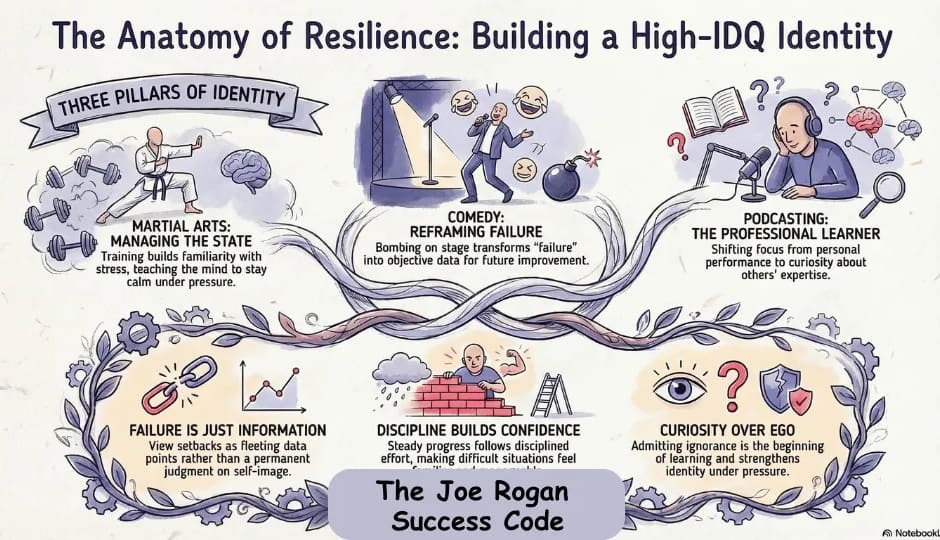
Where does the confidence and resilience come from to carry on as normal when the stakes are that high? It turns out, it didn’t happen by accident. It was built in three specific “rooms.”
The Long Build
Rogan has spoken about his teenage self with unusual honesty. He did not see himself as particularly formidable. He felt physically vulnerable and uncertain about where his life might end up. The quiet belief beneath that uncertainty, that if nothing changed he might end up becoming a “loser”, is familiar to many people.
Taekwondo altered the trajectory. Training introduced him to an environment where progress followed disciplined effort, simple and unsentimental. You trained, you improved, you came back the next day and did it again.
Over time something began to form under that kind of repetition. Stress became familiar rather than overwhelming. Difficult situations could be handled, and that knowledge stayed with him. This is the territory of Manage Your State, the body and mind learning to operate inside pressure rather than retreating from it.
Stand-up comedy added a different lesson. Every comedian eventually has the night when the material fails, the audience stays silent, and the energy in the room shifts in a way that is impossible to ignore. Rogan has talked about those nights with the same directness he brings to most things. Some sets went well, others did not, and comedy gives you immediate feedback either way. The choice was straightforward enough: step away from the stage, or come back the next night and try again.
He kept coming back. Over time the experience changed how he interpreted failure. A bad set did not say something true about who he was. It said something about the performance, and the performance could be improved. This is the skill of Outcome working as it should. Attention moves away from approval and towards improvement. Each performance becomes information.
Rogan later put it more cleanly than I could:
“The only time you lose is when you stop trying. Every failure is just more data.”
I love this language. Every failure is just more data. There is no drama in it, no self-pity, no special claim on the difficulty. A failure is a piece of information, and information is useful. That sentence does more work in describing the Elevate Formula than most explanations do.
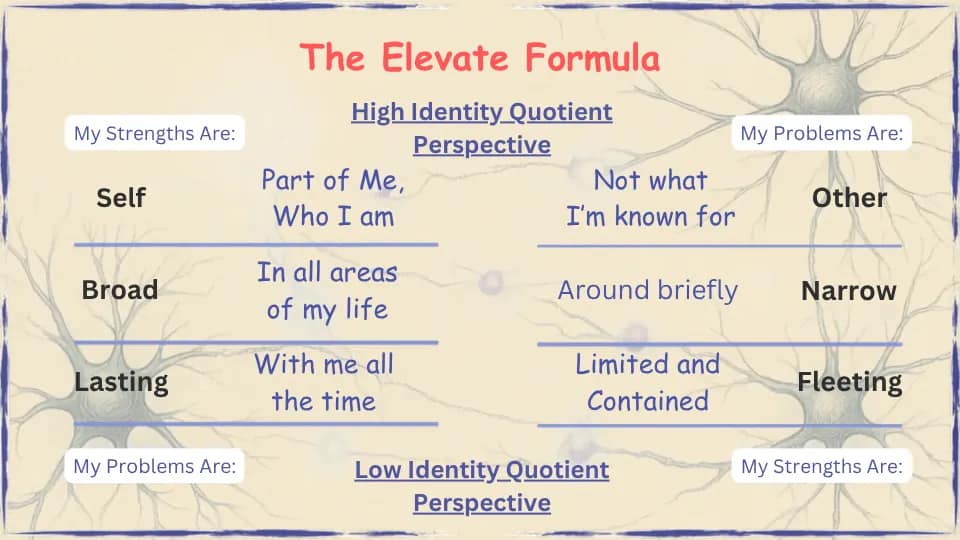
The Elevate Formula is what governs how someone interprets adversity. Difficulty can feel Self, Broad and Lasting: a verdict on who I am, applying to many areas of my life, and here to stay. Or it can be held as Other, Narrow and Fleeting: something external that touched one specific area and will pass.
Rogan’s quote is the second reading written out loud. A bad set is Other (it was the material), Narrow (it was tonight) and Fleeting (it will pass). Once that distinction is internalised, challenges become useful. They tell you something rather than damaging you.
How We Interpret Adversity
The “Sacred Flaw” View: Self, Broad, and Lasting. (“I failed because I am a failure.”)
The “Success Code” View: Other, Narrow, and Fleeting. (“The material failed tonight, but I can improve it tomorrow.”)
The same lesson kept turning up in different rooms. Sparring builds familiarity with stress at a body-level, where panic instincts have to be overridden in real time. Comedy builds tolerance for failure at a public level, where the consequences are immediate and visible. Podcasting, when it began, added something different again.
But physical and mental resilience were only two pieces of the puzzle. The final piece was linguistic.
The Phrase That Holds It Together
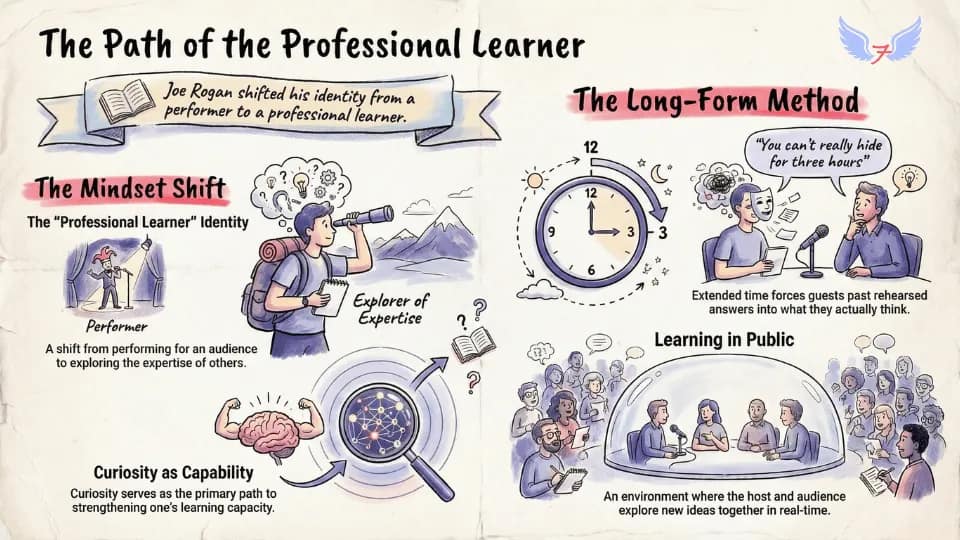
When Rogan and Brian Redban started recording conversations in 2009, the show was informal and often chaotic. Rogan has acknowledged that he talked too much in those early episodes, and the instinct came from years of performing.
Gradually it became clear that the most interesting voice in the room was usually the guest, and the conversations improved when the guest had time to explain how they actually saw the world. He adjusted the rhythm. His questions became simpler and more open. Guests were given space to think out loud.
The Practice Rapport skills were quietly developing here. Listening closely enough that someone keeps expanding their thinking. And asking questions that draw ideas out rather than shutting them down. Listeners notice the pattern in the opening minutes of nearly every episode.
“What have you been working on? What’s happened since the last time we spoke? What’s been occupying you recently?”
Only when something genuinely interesting comes up does he lean in further:
“Walk me through that.”
Three words again. The rhythm keeps the guest at the centre of the conversation.
And then there is the phrase I started with.
“I’m a professional learner.”
This is the one I find most revealing. It is not “I’m a top podcaster” or “I’m the most listened-to host in the world.” Both would have been defensible. What he chose is something more understated and structurally different.
Professional says it is serious, taken seriously, central to who he is. Learner says the position is one of curiosity rather than authority. Together the phrase quietly removes him from the role of expert and places him in the role of someone there to find out.
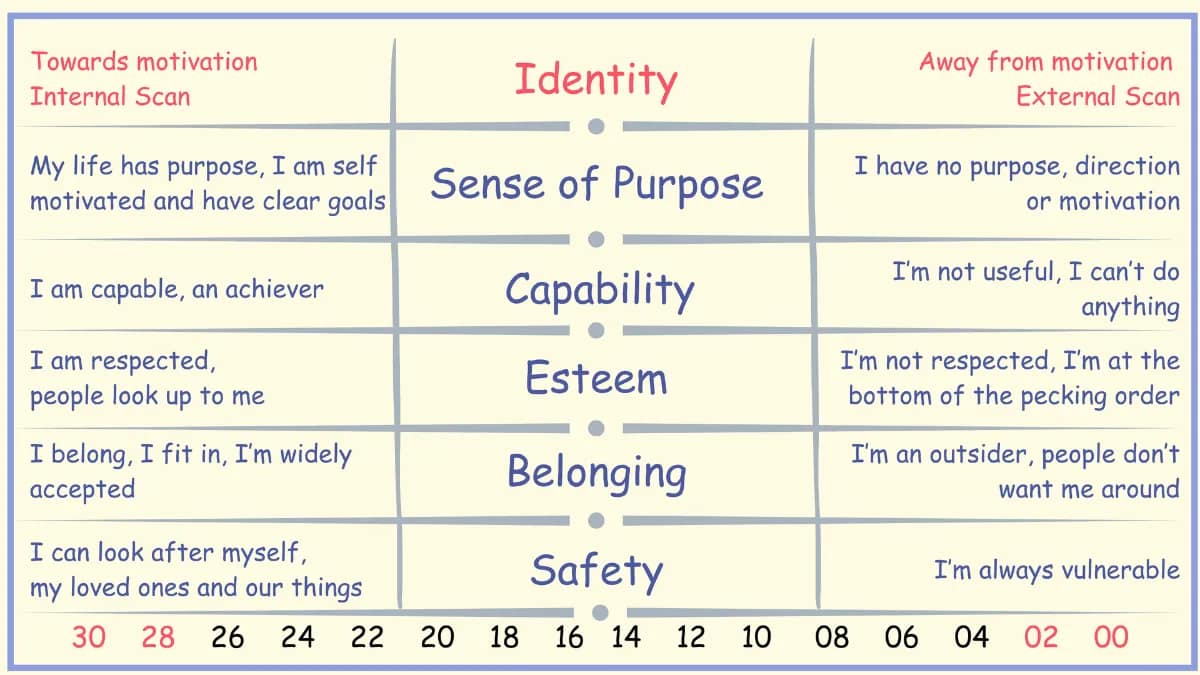
That is an Identity statement disguised as a job description, and it is what later allows him to stay calm under criticism. If your Identity is built on being an expert, an attack on your judgement attacks the centre of you. If your Identity is built on being a learner, the same attack is just more data.
Once that identity is in place, his explanation for why long conversations matter starts to make sense:
“You can’t really hide for three hours.”
Given enough time, people stop performing and start saying what they actually think. The podcast becomes a long, semi-public experiment in seeing how someone really sees the world. Rogan and his audience learn together.
When the Pressure Came
This is the Identity the controversy met. Criticism of several pandemic-era conversations had been building for months, and at a particular point it intensified.
Advocacy groups organised pressure on Spotify. Musicians, including Neil Young and Joni Mitchell, withdrew their catalogues. Media coverage escalated daily. Spotify staff spoke up internally. The platform was being asked, with increasing directness, why it was paying a reported $100 million to host a show attracting this kind of attention.
Then a compilation video circulated showing Rogan using the N-word in earlier conversations. The criticism shifted from individual episodes to his credibility and character, and the pressure became existential in the way these things sometimes do. People have lost careers over less.
He did not duck it. He addressed the language in the video publicly, apologised clearly, and acknowledged that it was wrong. He named some of his own failings and recognised that not everyone would agree with how he ran the show.
At the same time, he made the case for long-form conversation as something worth defending, including the disagreements that come with it. The response was calm, authentic, and respectful. He acknowledged the errors and stated his case for the work.
And then he carried on. Guests from very different perspectives kept appearing. Conversations remained long and exploratory. The pattern held, which is the part most people remember.
Seen across the timeline, the response is easier to understand. He did not suddenly develop resilience when the controversy hit. His Identity had already been trained through years of environments that quietly rewarded curiosity and persistence.
Martial arts had built the ability to remain composed under stress. Comedy had built tolerance for failure. Podcasting had built listening and curiosity. Those environments, taken together, shaped an Identity that treats mistakes as information rather than threat.
Within the Identity Model, this is the pattern of a high IDQ. Confidence here does not look like loud certainty. It looks like quiet stability, the kind that lets curiosity survive when the room becomes hostile.
The Success Code
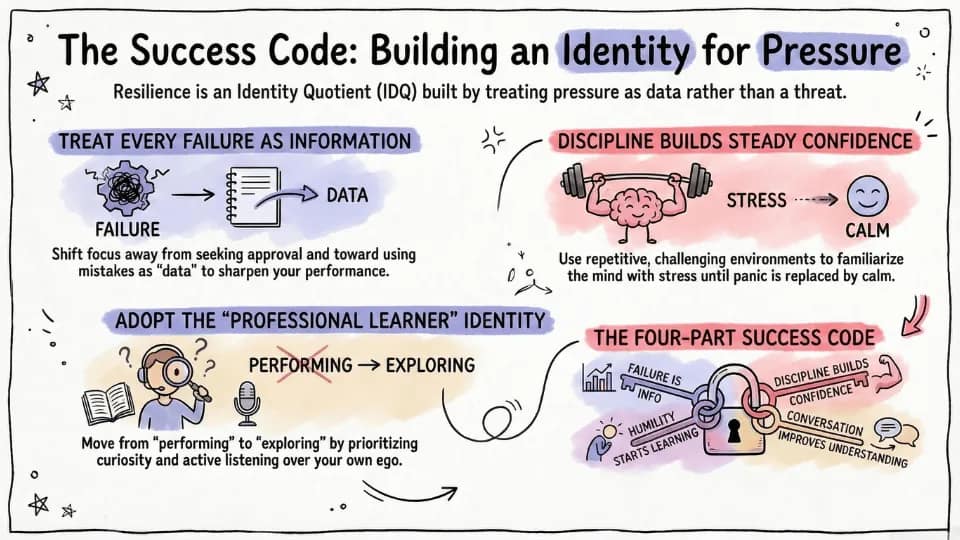
Working with people on this kind of pattern, I’ve noticed something consistent. The people who hold up under sustained criticism almost always have something in common, and it is rarely confidence in the surface sense. It is a small set of beliefs sitting underneath their behaviour that quietly determine how pressure gets interpreted.
Looking back across Rogan’s career, four of those beliefs appear again and again.
- Failure is information.
- Admitting you don’t know something is the beginning of learning.
- Long, honest conversation improves understanding.
- Discipline builds confidence.
Together they form what I’d call his success code. They shape how everything else gets handled. Mistakes become feedback rather than threats. Criticism becomes something to examine rather than something to avoid. The curiosity survives because the Identity is not constantly under attack.
Many people carry a different code, often without realising it. The 7 Skills corpus calls these Sacred Flaws: fixed limiting beliefs about ourselves that feel unquestionable.
“I’m not good enough.” “I don’t belong here.” “I’m not respected.”
Beliefs like these sit deep inside Identity. When pressure arrives, they narrow thinking and make every mistake feel like a confirmation.
The opposite version exists too. Call them Sacred Beliefs. These are the assumptions that strengthen Identity rather than weaken it, and they guide how someone interprets difficulty, criticism and failure. Rogan’s four are a clear example. Discipline builds confidence is a Sacred Belief. So is failure is information. So is admitting you don’t know something is the beginning of learning.
Seen this way, the resilience that surfaced during the Spotify controversy was not something that appeared in the moment. It had been built for years, in martial arts dojos and comedy clubs and recording studios that nobody was watching at the time. By the point the controversy arrived, the work was already done.
The Success Code behind Rogan’s continued strength wasn’t built in the heat of the moment. It was built quietly, and over time.
Confidence can be trained and the first step in building that stability is understanding the baseline of your own “Success Code.”
The IDQ Snapshot takes a few minutes to benchmark how you currently respond to challenge, criticism, and uncertainty. It is the starting point for the training detailed in The 7 Skills to impress™.


