The Secret to Confidence, All the Time, Everywhere
What a Breakthrough in AI Revealed About Why Confidence Can Be Consistent
Meera had just finished presenting to the board.
By any measure, it had gone well. She had answered questions clearly, stayed composed when pushed, and left the room with thanks from the chair. But walking back to her desk, one moment played on a loop in her mind. The finance director, midway through her third slide, had glanced down at his phone.
She turned it over all afternoon. Had she lost him? Had she said something that didn’t add up? Was there something in the numbers that he wasn’t happy with?
By evening, she had convinced herself the presentation had been a failure.
Her colleague, who had been in the same room, reviewed the same meeting later that day and called it one of the best sessions the board had seen all year.
Same room, same meeting, but completely different version of events.
The Same Moment, Different Reality
That gap is not about intelligence, effort, or skill, but something more fundamental. Once you understand it, confidence stops being context-dependent, available in some rooms and missing in others.
Instead, it becomes something you can build to be consistent. A landmark paper published by a group of AI researchers a few years ago helped make that unusually clear.
The paper was called Attention Is All You Need. The title was provocative, and was meant literally.
The researchers, led by Ashish Vaswani at Google, were trying to understand how machines could make sense of language and meaning. Their conclusion was that it was not about processing power or step-by-step logic.
It was about learning to weigh information correctly. To sift what mattered from what did not. To direct attention to the right signals and away from the noise.
That discovery transformed artificial intelligence and gave us the language models that now surround us.
It also, perhaps without the researchers realising it, described something that sits at the heart of how human confidence actually works.
Meera was not a person who lacked ability. Anyone who worked with her could see that. She was sharp, well-prepared, and clear under pressure when she trusted herself.
The problem was that her attention, trained over years, had learned to search for the wrong signals.
Attention Direction
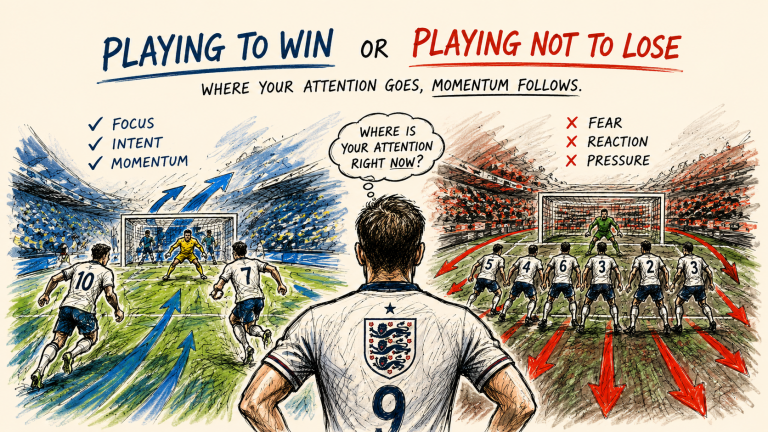
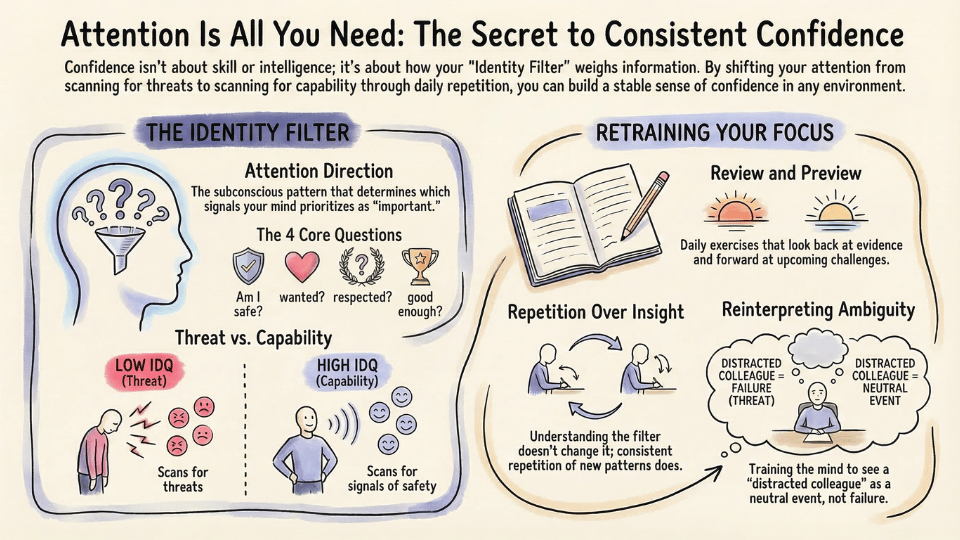
This is what the 7 Skills to impress™ framework calls Attention Direction: the pattern by which a person’s focus has been guided over time, first by the people around them early in life, and later by their own Identity.
Attention Direction is not a conscious choice. It runs underneath everything, like a filter the mind has built to answer a single question: what should I be paying attention to here?
For Meera, the filter had been set to scan for threat. Not because she had decided to do that, but because her Identity had quietly decided, across years and thousands of small moments, that this was the most important thing to watch for.
A neutral expression became a warning sign. A slow reply to an email became a signal she had offended someone. A pause before an answer became evidence that she had said something wrong.
She was not reacting to what was actually happening, but to the version of events her attention had already decided was her reality.

The 7 Skills Identity Model describes how Identity makes constant assessments about four things: am I safe, am I wanted, am I respected, am I good enough? These assessments happen below the level of conscious thought. They happen in the split second between seeing something and interpreting it.
Where someone sits on the IDQ scale shapes which answer the mind expects to find.
A lower IDQ means the mind scans for confirmation that the world is unsafe, that Belonging is fragile, and that Capability is unreliable. Not because the person is weak or pessimistic, but because the Identity has learned that scanning for those things is what keeps it protected.
Meera’s Identity had learned exactly that.
She could do strong work, present clearly, and build genuine relationships. But when an ambiguous signal appeared, the filter kicked in. The finance director’s glance at his phone became evidence of the thing she already feared.
Same Signal, Different Meaning

A higher IDQ reads the same signal differently. Not because it is naive, but because the Identity learned it does not need to scan for threat in order to feel safe.
The finance director’s glance at his phone becomes: he’s checking something. The pause before an answer becomes: they’re thinking. The quiet at the end of a meeting becomes: it went fine.
The same information. A completely different Outcome. All of it shaped by where Attention Direction has been trained to go.
This is one of the most important ideas in the 7 Skills framework:
Identity does not just interpret the world
Identity sifts, sorts and filters information and then directs attention so it can collect the interpretation it already expects.
I discussed the AI paper with Meera during a coaching conversation. It immediately made sense to her.
What struck her was the simplicity of it. The researchers had not built a smarter machine by making it faster or giving it more rules. They had made it better at deciding what to focus upon.
She had spent years working against her instincts. Trying to reason that she was far more capable and respected than she felt, and working to replace anxious thoughts once they had taken hold.
It was exhausting, and it never quite worked, because the filter was still running underneath creating her reality.
Eventually, she stopped wondering why she worried about how others saw her, and became curious about how her attention had been trained.
She began noticing, rather than reacting. When a meeting finished and she felt the familiar pull to replay it critically, she paused long enough to ask whether the evidence actually supported the conclusion her Identity had already reached.
Mostly, it did not.
Why Insight Is Not Enough

It was slow work. The pattern was years old, and understanding does not change a filter that has been in place since childhood. Repetition does, and we began work with Review and Preview.
Together, we looked over her work for the previous two weeks, and listed the Skills, Qualities and Attributes (SQAs) she had evidenced. It wasn’t easy to begin with.
There were weeks when the old pattern won. A presentation that had gone well, followed by two days spent convinced it had not. A project praised by a client, and then a week waiting for the criticism to arrive. The Identity is persistent. It searches for evidence that confirms what it has always believed.
But as we built up a pleasing list of SQAs, she also began to notice the moments when the filter shifted. The times she interrupted a negative interpretation before it set in. The times she could see the ambiguity in a signal and choose not to fill it with threat.
Those moments were small and easy to miss, but they were beginning to change the filter. Especially when we began to look forward with Preview, and imagine how those newly revealed SQAs would make the difference for challenges that lay ahead.
Then Came the External Consultation.
Meera’s firm had brought in external consultants to assess how the senior leadership team operated. The process involved individual interviews, a written assessment, and a presentation to the partners.
The partners would discuss the findings together. Some roles might change.
Every anxious tendency she had spent months trying to overcome came back with force.
She found herself overanalysing small exchanges with colleagues. Reading tension into rooms where there probably was none, and replaying conversations to check whether she had said something that would count against her.
By the third week, she was sleeping badly and had begun to dread going in.
We got together the day before her presentation. I asked her to stop trying to push her nervous feelings away, and instead write them down, carefully and plainly. Then we Previewed what she actually knew about the situation, and how her SQAs would help her to be at her best and the impression she would make.
The two lists were in stark contrast to each other. For Meera, it was like bringing two starkly contrasting Universes into view. She could see the life of worry and limitations she had been living, against a world of confidence and opportunity that was available to her.
And she could see so clearly, for the first time, how a retrained Attention Direction could change her life for the better.
Then she walked herself forward through the presentation she was about to give. In full awareness of her SQAs, and with the preparation she had done and the knowledge she actually held.
The next day the presentation went well. She knew that this time, not because someone told her, but because the signals and feedback in the room had been reframed by a refocused Attention Direction.
She noticed things she would previously have missed. The chair nodded at a particular point. A partner she had found difficult to read asked a follow-up question that showed she had been paying close attention throughout.
The finance director was there again. He kept checking his phone. “He’s got an attention problem,” thought Meera.
What Confidence Actually Is
Confidence, the 7 Skills framework argues, is not simply a personality trait or something some people are born with and others are not. It is a pattern of Attention Direction that has been built over time, across thousands of moments, by the people and environments that shaped it.
And patterns can be changed. When Attention Direction is trained towards signals that confirm Capability and Safety, confidence becomes stable. It becomes available in all contexts, familiar rooms and unfamiliar ones, under ordinary pressure and the kind that keeps you awake at night.
The researchers who wrote Attention Is All You Need were solving a different problem. But the insight holds. Change where attention goes and you change what meaning gets constructed from the same information.
What Meera was learning to do, piece by piece, was train her Attention Direction towards signals that confirmed capability and safety, rather than those that confirmed threat. That shift does not happen from understanding it once. It comes from the quiet repetition of looking back at what actually happened and looking forward at what is actually coming, honestly and consistently, over time.
The IDQ Snapshot will give you a picture of your confidence under pressure in three minutes: