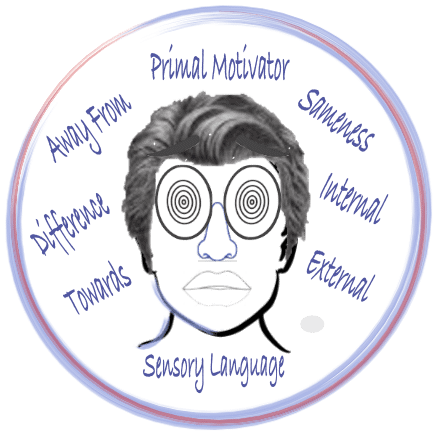
As I began talking to the rugby squad, I knew I wouldn’t be able to elicit their individual Persuasion Pathways (PPs). This is always an issue when working with groups.
Instead, as I explained above, I used my tried and tested Rapport technique which worked very well. In the process, I heard the squad, in their own words, describe their SQAs.
So, I used their words back to them. I interwove as many as I could into my inspiring talk. And I used a combination of sensory styles, towards and away from, internal and external. I would mix them in the same sentence, e.g.;
By applying your skills and strengths, you can avoid the early setbacks and get on the front foot early in the game. Then you’ll feel like you are on top and see the pressure you are putting the opposition under. (Towards, away from, feeling, seeing).
And
When you see them wilting, and you hear the opposition complaining, you know inside this is your time. (Internal, external, listening, seeing, thinking).
In this way, I spoke to the whole group in a manner they could effortlessly accept.
That’s all fine, but it still left me wondering how I could bring Persuasion Pathways to life for you, the reader, in one-to-one situations.
I was thinking this through as I watched an interview with a famous celebrity. I found it easy to pick out his PPs from his language. He gave up plenty of cues that revealed Identity and Primal Motivator too.
I could see what an interesting way this is to reveal PPs in real time. So I’ve selected a few celebrity interviews for us to look at.
There are excerpts from interviews with Mohammed Ali and Lebron James. Then there is a video interview with Leonardo DiCaprio. It’s fascinating stuff.
Please read these passages and see if you can tell what Persuasion Pathways are revealed in their language. After each one, I offer my insights about what it tells us about how they create their Edited Reality and the secrets to their success.
It will help you to take the Sensory Preferences Test if you haven’t already. This has a lot of info on how the above factors affect a person’s instincts and Edited Reality.
Mohammed Ali
Taken from The 42 “8 of the most revealing sporting interviews ever published”. Oct 13th 2016.
Ali was interviewed immediately after he fought and won against George Foreman in the infamous “Rumble in the Jungle”. A win that meant he was seen as the greatest boxer of all time.

“The trick was to make him think he was the baddest man in the world and everybody had to run from him. Truth is I could have killed myself dancin’ against him. He’s too big for me to keep moving round him. I was a bit winded after doin’ it in the first round, so I said to myself: ‘Let me go to the ropes while I’m fresh, while I can handle him there without gettin’ hurt. Let him burn himself out. Let him blast his ass off and pray he keeps throwin’. Let it be a matter of who can hit who first, and that’s me.’ This was a real scientific fight, a real thinkin’ fight. For me it was. Everythin’ I did had a purpose.”
Thinking
He talks about thinking in the first sentence and third from the last. Also, when he mentions talking to himself, these are all signs of a Thinking style.
Feeling
All the references about running, dancing, moving, being winded, getting hurt, keep throwing, blast his ass off etc. All these comments about moving and emotions signal a Feeling channel. There’s more of this style than any other, suggesting it’s a dominant Persuasion Pathway.
Towards
It’s notable that, even under immense pressure, he is planning to get on the front foot. He could have easily focused on how to keep away from Frasier to avoid his punches. But his focus is on “how to handle him”.
Internal
In this passage, he never mentions what anyone else may think. He listens to his own thoughts and internal reference. It’s one of the characteristics that make him so mentally strong.
“Ali would have been a High IDQ…

That’s perhaps not a surprise for a man who regularly called himself “The Greatest”. These quotes show that he was also a thinker. An intelligent man who could problem-solve under immense pressure.
His Towards channel means that his thinking is focused on achieving his goals rather than avoiding problems. And he was not a man to suffer from self-doubt. His ‘Internal’ reference would always guide him, and he’d not be distracted or weakened by noise from the outside.
Because his Feelings channel is dominant, Ali’s Internal reference would have been an emotion. As Ali came up with his plan, he would have felt confident, maybe determined and perhaps even superior.
He would have been internally focused, with no doubt or distraction.
In Ali’s words, we can find ample evidence of the mental strength that provided that foundation to perform at an exceptional elite level.
LeBron James

Taken from The 42 “8 of the most revealing sporting interviews ever published”. Oct 13th 2016
This quote from Le Bron was made when he was 18 years old. It’s fair to say he lived up to the hype.
“A lot of players know how to play the game, but they really don’t know how to play the game, if you know what I mean. They can put the ball in the hoop, but I see things before they even happen. You know how a guy can make his team so much better? That’s one thing I learned from watching Jordan.”
Thinking
Note the phrases, “know how to play… if you know what I mean… You know how a guy… I learned from… These are all signs of a Thinking Persuasion Pathway.
Seeing
Clearly, “I see things before they even happen” is a visual PP.
Towards
His language is all about achievement and making things happen. He’s very ‘Towards’.
Difference
LeBron talks about seeing what everyone else can see. But he also mentions ‘Difference’, e.g. “… some players see things before they happen”.
Internal
His language is very decisive and based on his internal reference. He may learn from Jordan by watching him, but he decides what he takes away. There’s no reference here of reacting to external feedback.
“LeBron is clearly a High IDQ…
… his ‘Towards’ and ‘Internal’ channels underpin his immense self-belief and mental strength.

I’ve always thought that one of the things that made him stand out in a field of supreme athletes was his ‘Difference’ channel. So many outstanding athletes in the NBA could perform at the same level. But LeBron was blessed with an ability to see and take advantage of things that most other players didn’t see. The ‘Difference’ that made the difference.
I hope you found these brief reviews of celeb’s language interesting. A great way to develop your know-how with PPs is to look up interviews with your favourite stars. And then, as you read through, check for PPs one by one, e.g.;
- Sensory speech; are they talking about what they see, hear, feel, think, smell or taste? Is there more than one style going on?
- When they talk about a choice they’ve made, how do they judge whether it was a good one or not? Look out for an internal or external source of review and approval.
- Do they talk most about moving towards goals or away from troubles?
- Do they talk about various moments in their life as being the same or different?
It will help you to take the Sensory Preferences Test if you haven’t already. This has a lot of info on how the above factors affect a person’s instincts and Edited Reality.
As you look over these ideas, think about what this means for the people whose speech you are reviewing. And how it helps you see how they make sense of the world around them. In other words, how they put together their ER.
And once you’ve got a feel for these ideas, think through how you might speak to them to build Rapport. And how would you use those PPs to inspire them?
Once you’ve done this a few times, you’ll find that PPs jump out at you. You’ll notice this as you read what someone has said, watch an interview with a celeb, or even talk to a friend.
So, when you’re ready, watch this clip with Leonardo De Caprio talking to the Actors Guild. It’s a telling glimpse into the secrets of his success and mental strength.
As you watch it, there are many of the cues I’ve noted above. And at the end, I’ll reveal some fascinating extras that pop out of Leonardo’s language when you learn how to detect them.
Leonardo De Caprio
Internal
A message that comes through clearly from the whole interview is how Di Caprio references his own decisions. He’s not so internal that he won’t listen to opinions he respects. Leonardo talks about his father, actors and directors who have influenced him. But at the end of the day, he listens to his own ‘feelings’ on which way he should go.

Difference
I’ll talk about this more when I discuss his Primal Motivator below. But for now, note how often he says he likes a role because it’s different.
Towards
Note how he pursues a film. He works towards getting his pet projects “greenlit”. Some take years, but he always looks to find a way forward.
He talks about wanting to work with directors such as Tarantino and Scorcese. As DiCaprio does so, he focuses on what he wants to happen rather than what he wants to avoid.
His ‘towards’ motivation is especially clear when he talks about his part in Django Unchained (51 mins 45 secs). It’s risky because he plays a racist who often uses the ‘N’ word.
DiCaprio didn’t want to duck this role or change the script to avoid controversy. Instead, he talks about the main black actors, Jamie Foxx and Samuel L Jackson, encouraging him to tackle it “head-on”.
He explains that…
“… if you don’t play this guy as the worst possible son of a bitch that could ever be, people are going to think we sugar-coated this issue, and it’s an important issue to talk about as far as American history is concerned…”
Thinking & Feeling
It’s clear how the prospect of playing some of the characters in his films excites Dicaprio. He talks about how he ‘feels” about the scripts and roles.
And he gets visibly energised as he discusses them, moving forward in his seat and using his hands and arms to help convey his feelings. These are the parts of the interview where he gets the most involved and lets down his barriers. These are all clear ‘Feelings’ signals.
His research into roles is impressive. For the film “What’s Eating Gilbert Grape?” [21.20] the director, Lasse Hallstrom, gave him a video of someone he wanted to model his part on. He says he obsessively watched that for a week. He also spent about a week in a home in Austen, Texas, for kids with similar mental issues to the character he played. He studied the kids there to help develop the role.
For ‘The Aviator’, he says he met as many people as he could who had known Howard Hughes. For the Great Gatsby, he read the book and the original, unpublished text, ‘Trimalchio’, which was the source from which the famous version evolved. He did this because it gave more of the motivation and back story of the characters that informed his portrayal.
His research shows his desire to understand the characters he’s playing. A strong ‘Thinking’ trait.
Primal Motivator
It was exciting to note that DiCaprio’s Primal Motivator was revealed in this interview. And it’s closely linked to his ‘Difference’ focus.
Early in the interview, DiCaprio talks about the audition for ‘This Boys Life’ when he was down to the last five hopefuls. He says;
[12.10] “… I just thought, I’ve got to do something, I’ve got to do something to stand out…”.
It led him to take a big risk in an audition with co-star Robert De Niro. It paid off as he got the part.
Throughout this interview, you can see how he gets excited about films and characters that stand out. And indeed, at 56.55, he talks about how he was “blown away” (Feeling) by the Australian actors and staff for the filming of Great Gatsby. He explains how impressed and inspired he was by their ferocity to ‘stand out’.
It was the same when he talked about why he wanted to do the Gilbert Grape film. He had been offered a high-paying role in a Disney Film, which he turned down in the hope of being offered this role.
[20.30] “… a special kind of character and really go for something a little different …” (he nods as he says this, which reveals that this is something big for him.).
This is his way of talking about “Difference.” The people behind the film wanted the part to stand out, and that made the role very appealing to him.
That is some motivation! To turn down a lucrative Disney picture when you’ve no guarantee of getting the film you’ve rejected it for. That’s the power of Primal Motivators.
Identity

A fascinating insight comes from his comments on his experiences as a struggling 11-12 year old kid going for auditions. [7.20]
He notes how he was conditioned to behave. He would make out he was a Jack of All Trades who could do anything the casting directors wanted, whether or not that was true. But this “aggressive” approach just got him rejections.
Then he made a change. He reflected on his strategy at an Identity level.
[8.20] “… I suppose I took a different attitude to the audition process, and I started to get jobs after that. I think it was really because I said to myself, you know, I’m not dependent on this job … this isn’t going to define me … I started to sell myself less, prepare more for the roles … really investigate the characters as much as I could and not feel like my, you know, self-worth was on whether I booked the job or not …”
This is a classic High IDQ attitude. He separates success and failure from a judgement of his worth. I.e., he makes it ‘Other’. This allows him to concentrate on the role rather than pretending to be someone he’s not.
“The secrets of DiCaprio’s strength of character and success…
… can be gleaned from his words. He is his own man (Identity), internal and ‘Towards’ motivated. These characteristics lead to a solid and determined mentality.
Di Caprio is motivated to take on roles that really stand out. He’ll research his character until he understands it well and feels that the part is right for him and he’s portraying it the best way he can.
And he has the strength to be true to himself. Because he doesn’t need acceptance by others to prove that he is safe, wanted, respected and capable. He believes that about himself, whether or not he gets the role.
And that frees him up to concentrate on playing the character in the film the way he believes is right. Rather than the way he thought the casting director wanted.
It will help you to take the Sensory Preferences Test if you haven’t already. This has a lot of info on how the above factors affect a person’s instincts and Edited Reality.
Up Next
We return to the clubroom and see how the Elevate Formula played a massive role in my success for this talk. Click here.