

Your Identity shapes how you see challenge, how you handle pressure and how others experience you. Your Identity Quotient reveals the pattern underneath.

Identity Quotient Explained
We’ll look at the power of a High IDQ and how it unlocks a healthier, happier, and more rewarding life, and why it makes you more influential and popular.
This chapter will show how parents and teachers with a High IDQ light up their children’s motivation and Sense of Purpose, and how they nurture their self-esteem and confidence.
It covers how High IDQ coaches and leaders release the skills, abilities and qualities of their people. And lift their athletes, workers and teams to elite-level performance.
We’ll also talk through some advantages of a Low IDQ.
In this chapter (quick index)
- What IDQ is, and why it drives confidence, health, and influence
- The score ranges (Low / Mid / High) and what they feel like day-to-day
- High vs Low IDQ across the Identity Model: Safety, Belonging, Esteem, Capability, Purpose
- How Explanatory Style shapes resilience (and performance of those you lead)
- The Anabolic vs Catabolic states (health & longevity implications)
- Real-world applications for parents, teachers, coaches, leaders
- The useful side of a Low IDQ, and its hidden costs
If you haven’t already, take your three-minute IDQ Snapshot and see where you sit.
What’s the Difference between a High and Low IDQ?

The 7 Skills to impress™ Identity Model shows the Identity Quotient scores along the bottom. The details I give here describe an acute example. So, as you read, please keep your score in mind and adjust to a milder take if you feel it fits better.
First, Let’s Take a Look at the Numbers in Red, the Outliers
Someone who scores 28 to 30 is probably overly confident. They are not inclined to critically review their actions because they:
- Totally believe in themselves.
- Seldom accept they are at fault when problems occur.
- Are very bad at taking feedback from other people.
People who score this high can be hugely inspirational. But over time, they tend to lose trust as they come to be seen as out of touch with reality.
Scoring within the 0 to 2 group suggests a very downbeat state of mind. If you score here, then please look out for the following symptoms and seek help if you see yourself in this list:
- Feelings of sadness, tearfulness, and emptiness.
- Angry outbursts, being grumpy, even over small matters.
- Loss of interest in most or all normal activities, such as sex, hobbies or sports.
- Poor sleep, unable to sleep or sleeping too much.
- Tiredness and lack of energy, so even small tasks take extra effort.
- Loss of appetite and weight loss or cravings for food and weight gain.
- Constant worry.
- Slowed thinking, speaking or body movements.
- Feelings of failure or guilt, fixating on past failures or self-blame.
- Unable to think clearly or focus, with poor memory.
- Often thinking about death or suicide.
- Worrying about illness or issues, such as back pain or headaches.
IDQ and Safety

A person with a High IDQ is more likely to see opportunities around them than threats, which makes them generally more relaxed. They believe they have what it takes to keep themselves, their loved ones and their possessions safe.
Low IDQs don’t believe they have the Skills, Qualities and Attributes, or SQAs, to look after themselves or their loved ones. So, they tend to read threats and problems into many more issues than the average person. This makes them nervous and less willing to take on a challenge or risk.
IDQ and Belonging

A High IDQ person enjoys social interaction at work or in their private life, and they assume they will be welcome in a group setting, whether with old friends or new people.
If things don’t go perfectly, they are less likely to be put off. And they are more receptive to the openings that networks of friends and contacts tend to generate.
Low IDQs fear rejection and doubt whether they are popular or even wanted in social gatherings. And so, they can be nervous and easily offended.
Building networks of friends and contacts is a struggle for Low IDQs. They assume their views will not be respected, so they are reluctant to share them, limiting their chances for growth socially and at work.
IDQ and Esteem

People with a High Identity Quotient are happy to share their ideas and views because they expect to be respected. Their self-esteem is healthy, so they don’t take disagreements or setbacks personally.
Low IDQs believe their lack of popularity and respect is behind everyday conflicts and disputes. And so they are more sensitive and easily offended by seemingly harmless comments.
IDQ and Capability

A High Identity Quotient person sees a problem as manageable. They are not ashamed or embarrassed by a setback because in their Edited Reality, it isn’t a reflection of their Identity.
They believe they have the Skills, Qualities and Attributes, or SQAs, to cope with and succeed at any challenge. And if they are lacking, they assume they can learn them or find the help and support they need.
And so, their outlook is that:
A Low IDQ finds setbacks stressful and often feels overwhelmed by problems. They don’t feel confident in the face of a challenge. This is because they see:
- Adversity as Self, Broad and Lasting.
- Their SQAs as Other, Narrow and Fleeting.
This is why they are often embarrassed by setbacks because they believe they reflect their self-image. They doubt themselves and may view challenges and new opportunities as things to avoid.
IDQ and Sense of Purpose

I covered this in Part 1 of the 7 Skills Book, Chapter 4, Part 2. This is what I said there.
Someone who feels safe can look up and be aware of what’s happening around them. If they think they fit in and belong, they will feel part of things and want to shape them.
A good Esteem score means they are used to airing their views and being taken seriously. And the Elevate Formula empowers them to back their skills against any problem they face.
So High IDQs feel useful. They have something valuable to contribute. Which all adds up to a desire to make a difference, a belief that they can do so and that it is their purpose. It leads to a life filled with ambition, motivation and intent.
Individuals with Low IDQ traits may have low confidence, feel they have little to offer and become frustrated when trying to get their ideas across.
They may struggle to find meaning in their daily lives and feel unhappy with their personal and work goals. This can affect their overall sense of happiness and well-being.
IDQ and Internal/External

An ‘Internal’ person is confident in their own mind. They will take some convincing if you disagree with them. They appear to be sure and unmoved by criticism.
They may miss helpful feedback because they ‘edit it out’ if it doesn’t match their thinking.
An ‘External’ person will worry about what everyone thinks of them. And so, they often change their minds and moods. They need regular reassurance, they take criticism hard and can appear needy or negative.
IDQ and Towards & Away From
High IDQs have a confidence and self-belief which tilts their motivation in a Towards direction. So, when confronted by a challenge, they are more likely to seek a solution rather than avoid or deny the issue.
Low IDQs are typically “Away From”. They don’t have confidence in their SQAs when faced with a challenge or a problem. And their low self-esteem can mean that even everyday issues can look risky to them.
And so, Low IDQs tend to avoid, deny or move “Away From” things that feel uncomfortable for them. This means they can spend their whole lives avoiding issues and achieving very little.
Health, Happiness and Success
Low IDQ and the Catabolic State
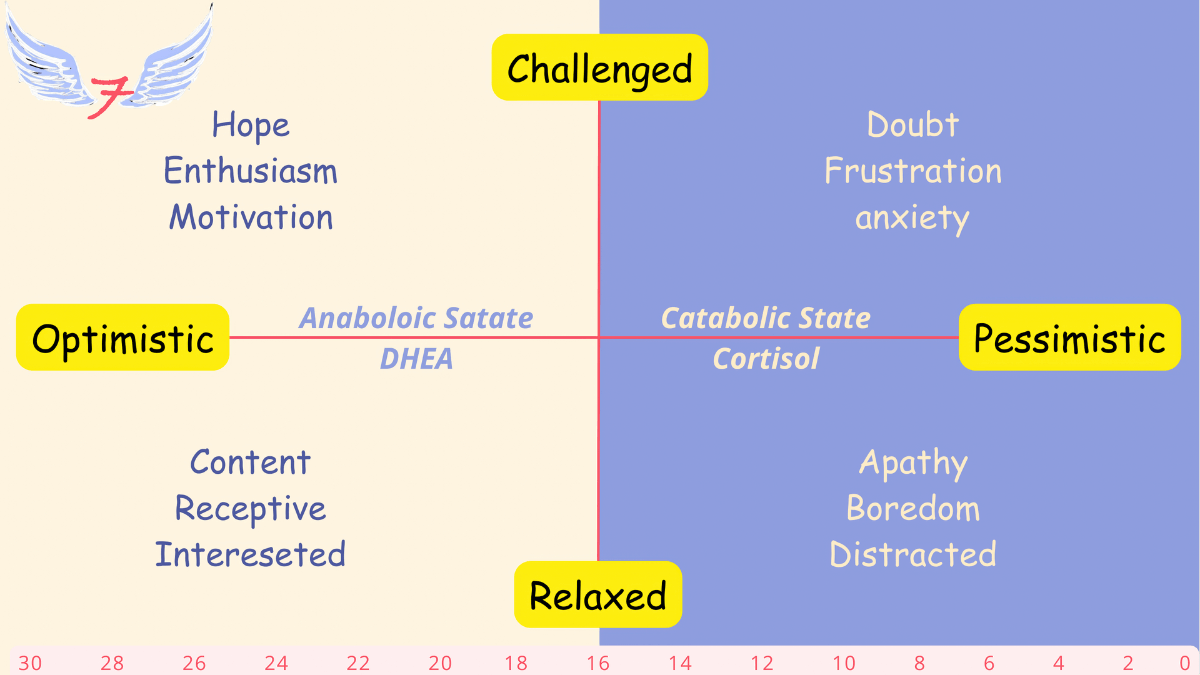
As you can see from this diagram, a Low IDQ outlook leads to Catabolic State (CS). CS has many unwelcome effects on a person’s health, happiness, and success. Such as:
- Health: Stress has been linked to many health problems, such as heart disease, diabetes, and a poor immune system. It can also lead to tiredness, poor sleep and mental health problems.
- Happiness: It can lead to anxiety, sorrow, and burnout. This will reduce a person’s overall sense of joy and well-being.
- Success: Stress and downbeat emotions can also affect a person’s ability to perform at their best by reducing their ability to learn, reason, and solve problems. It lowers motivation, confidence and resilience.
When you’re in a CS, the body releases more cortisol and adrenaline. These chemicals are meant to be a short, sharp boost during the Fight, Flight or Freeze response.
But if you are stressed for a while, they remain in the body longer than intended. The immune system gets tied up trying to clear them out, so it’s not defending you so well from sickness.
If you’re finding it hard to shake off an infection, it can be a sign that your immune system is busy this way. On top of that, when these chemicals stick around, they speed up the ageing process.
High IDQ and the Anabolic State
The High IDQ score is on the left-hand side of the box, and it is linked with the Anabolic State (AS). This is a healthy, happy and successful state to be in, and a big predictor of longevity.
- Health: High IDQs can see the positive in most situations, which helps them keep a healthy mind and attitude. This state of mind is one in which healing and happiness chemicals, like growth hormone and serotonin, are produced. Their immune system works well, protecting them from illness.
- Happiness: Upbeat emotions, such as joy, gratitude, and contentment, can boost well-being and promote healthy relationships.
- Success: High IDQs are more likely to remain confident and resolve problems. When faced with adversity, they may seek creative answers and, if needed, help from their friends and contacts. High IDQs find an ordeal less stressful than Low IDQs. This means they learn from their mistakes, problems and accidents and move on. And so, High IDQs can bounce back from disappointment more easily.
The lower half of the box shows our state of mind when relaxed. Again, the right-hand side is not a happy or healthy place to be.
This is why research suggests that having a High IDQ outlook is better for coping with problems and being resilient. High IDQs are more likely to be happier, healthier and more successful than Low IDQs.
Inspiring Confidence, Belief and Mental Strength
Explanatory Style
In Chapter 4, we talked about the Elevate Formula (EF). We saw how it shapes your language in everyday speech. To recap, if you have a High IDQ, you will:
- See a challenge as Other, Narrow and Fleeting.
- Think of your SQAs as Self, Broad and Lasting.
- Believe your SQAs give you the capability to deal with the challenge.
The outlook of a Low IDQ is the mirror image of these three positions.
Because we talk instinctively when dealing with everyday events, our natural form of Elevate Formula streams out in our every spoken word, judgment and reaction. This is called our Explanatory Style (ES).
Our Explanatory Style has a huge effect on the people around us. With it, parents, carers and teachers unwittingly shape a child’s self-esteem. And for coaches and leaders, it dramatically affects their people’s performance, motivation and resilience.
Low IDQ Explanatory Style
A Low IDQ’s Explanatory Style makes a child nervous and uncertain in the face of a challenge. It creates brittle and underperforming teams. This is because they learn that:
- Adversity is Self, Broad and Lasting.
- Their SQAs are Other, Narrow and Fleeting.
The Low IDQ language structure is downbeat. And so, a Low IDQ will naturally, unthinkingly and routinely teach that adversity is stressful and problems are overwhelming.
High IDQ Explanatory Style
A High IDQ’s Explanatory Style helps a child grow into a healthy, happy and successful adult. It creates individuals and teams that are more confident and resilient.
A High IDQ’s words are naturally uplifting. They teach us that adversity is less stressful because it won’t last, it’s not about us, and we have the SQAs to overcome.
And so, a High IDQ will naturally, unthinkingly and routinely teach confidence, belief and mental strength, tools everyone needs to thrive in a challenging world.
Modelling Explanatory Style
Explanatory Style isn’t just mirrored in your language. It’s reflected in your reactions to everyday problems.
Children model themselves on how they see their parents, carers, and teachers behave. And coaches and leaders define the beliefs and values they want for their brand through their words and actions.
Here are some key outcomes from modelling. To be brief, I have only given the High IDQ perspective here because I think it’s easy enough to figure out the reverse Low IDQ position.
- High IDQs are more patient and calm. So, they are less likely to get frustrated or angry during the challenging moments everyone experiences from time to time.
- High IDQ people are generally more supportive and encouraging, which can help their children develop confidence and self-esteem. It deepens Rapport between coaches, leaders and their people.
- High IDQs are more likely to adapt to change and be open to new ways. This can be particularly important in parenting. Children grow and develop quickly, and keeping up with their evolving needs and nature is vital for a healthy mind. And in sports and business, research has shown that forward-thinking and flexibility support survival, growth and success.
- High IDQ coaches and leaders are calmer under pressure. They engender respect, and even a dressing-down can be empowering when couched in Elevate Formula terms.
- High IDQ parents, teachers, carers, coaches and leaders naturally use setbacks to build self-belief and resilience because they will phrase the problem as Other, Narrow and Fleeting, while addressing SQAs as Self, Broad and Lasting.
Positives of a Low IDQ
Some readers with a Low IDQ score may counter what I say above and point to many successes in their lives. And indeed, there are some positive results from having a Low IDQ.
So we’ll take a look at this side of the coin now. But I’ll also explain why the successes of a Low IDQ may come at a cost.
To kick us off, here are a few of the reasons why Low IDQs are equipped to succeed:
- Lower expectations: Low IDQs are less likely to be surprised if things do not go to plan. This can lead to greater resilience.
- Being prepared: Low IDQs are more cautious and prepare for things to go wrong. This can be useful where being ready for the worst-case scenario can help avoid disaster.
- Realistic: Low IDQs tend to have a more realistic view of problems and are less likely to overlook likely risks or dangers. This can help them avoid making costly mistakes.
The Value of Low IDQ Caution in High-Risk Situations
In my police career, I found Low IDQs could be very useful. I led many high-risk operations that exposed my officers and the public to danger. Failure in these jobs could be catastrophic.
When I was planning with my team for a tricky operation, the Low IDQs were the ones most focused on all the potential pitfalls. The trouble for them was how they would express their caution. They’d typically say something like:
Oh, you can’t do that boss because…
This caused most people to dismiss them as ‘negative’. But I’d ignore the sentence’s first half, listen for what came next, and take note. And then, I would adapt my plans to cater for the difficulties they’d foreseen.
I was grateful for how their caution balanced my optimism. And that my jobs went well because of the steps I’d built in following their feedback.
Burnout and the Search for Success
I have coached many successful people with a Low IDQ. And it became clear to me that they share a couple of common traits:
- They are never satisfied with anything they have achieved.
- They feel every slip-up or setback deeply.
Their successes seem to come from a drive to prove themselves. They show huge resolve as they push themselves on, looking for the success that eventually proves they are ‘good enough’.
But their low self-image never lets them feel good about their achievements. The Elevate Formula ensures they see their wins as Other, Narrow and Fleeting.
And any slip-up or setback hurts them deeply because they feel those moments are a true representation of who they are. In other words, they instinctively frame their failures as Self, Broad and Lasting.
No amount of success changes this, and by the time they come to me for coaching, this constant battle to prove themselves has left them feeling burnt out.
What Would You Choose? High or Low IDQ?
I’ve been that Low IDQ person, continually pushing myself out of my comfort zone and searching for the success that would prove my worth. And nothing I achieved changed my Identity Beliefs, Sacred Flaws and the Edited Reality they created for me.
I worked out how to make a change for myself and move my IDQ score into the High IDQ range. And for over twenty years, I have helped parents, carers, teachers, athletes, coaches and leaders to do the same.
So I know what the difference feels like, and I’ve seen the change in others. After years of working with the 7 Skills and coaching, assessing and advising too many people to count, I’d take High over a Low IDQ any day.
I’d happily swap a little realism for a bit more optimism. I’d recommend aiming for a score anywhere from 15 to 22, preferably to the higher end of that range, and enjoying the happy, healthy and fulfilled life it offers.
This is the job the 7 Skills to impress™ were built to do.
What You’ve Just Learned and Why It Matters
In Unleash Your Potential, you’ve seen how your IDQ, your Identity Quotient, quietly governs your confidence, performance, well-being and relationships.
You’ve learned that:
- A High IDQ unlocks clarity, resilience and inner peace, even under pressure.
- A Low IDQ can fuel anxiety, self-doubt and burnout, even in success.
- Your IDQ not only affects how you experience life, but it also affects how others experience you.
High IDQ parents, teachers, coaches and leaders naturally raise the performance, belief and self-esteem of those around them.
Low IDQ role models can unconsciously limit others, simply by the way they speak, respond, and lead. Most importantly, you now know that this isn’t fixed. Your IDQ can grow. And with it, your impact, your influence, and your inner strength.
Do you know your IDQ? Click this button, and in less than three minutes you’ll get your snapshot. (None of your personal data is shared.)
What’s Coming Next and Why It’s Important
Part 1 has given you clarity.
You now understand how your Edited Reality is constructed.
You can see how early beliefs still shape your reactions under pressure.
You know that Identity rests on the foundations of Safety, Belonging, Esteem, Capability and Sense of Purpose, and that the strength of each one influences the composure you bring into difficult moments.
But clarity does not change a pattern.
Patterns change through repetition.
That is why two things come next.
First, you measure where you are.
Revisit the IDQ Snapshot.
Note your score. This is your baseline, not a diagnosis, simply a starting point. IDQ can strengthen over time as your explanatory habits shift.
Part 2, The 7 Skills to impress™ equips you to operate at your best under pressure, regardless of where your IDQ currently sits.
The Skills give you practical tools to:
- Manage your emotional state
- Build Rapport that strengthens influence
- Use language that lifts confidence and resilience
They allow you to act with clarity and steadiness even while your deeper patterns are still evolving. And as you practise them, they reinforce the very Identity foundations that support long-term change.
You will return to Jacqui’s story and hear exactly what Eddard said and why it worked.
Up Next: Part 2 of The 7 Skills to impress™: The 7 Skills
Skill 1: Identify Your Outcome
Previous Chapter
Index
Glossary of Terms
Further Reading
Please also see the further reading for Chapters 4 and 5.
Chang, E. C., & Sanna, L. J. (2001).
Optimism, pessimism, and positive and negative affectivity in middle-aged adults: A test of a cognitive-affective model of psychological adjustment. Psychology and Aging, 16(3), 524–531.
Chang and Sanna examined how optimism and pessimism relate to life satisfaction, depressive symptoms and emotional outlook. This supports the chapter’s point that the way we expect life to unfold affects our well-being, confidence and everyday emotional state.
Soll, J. B., & Klayman, J. (2004).
Overconfidence in interval estimates. Journal of Experimental Psychology: Learning, Memory, and Cognition, 30(2), 299–314.
Soll and Klayman explored how people often feel more certain than the evidence justifies. This is useful for the section on very high IDQ scores, where confidence can become less grounded and make feedback harder to accept.
Rasmussen, H. N., Scheier, M. F., & Greenhouse, J. B. (2009).
Optimism and physical health: A meta-analytic review. Annals of Behavioral Medicine, 37(3), 239–256.
Rasmussen and colleagues reviewed research linking optimism with physical health outcomes. Their work supports the chapter’s wider argument that a more hopeful and constructive outlook can affect more than mood; it can influence health, resilience and the way people cope with adversity.
Gillham, J. E., Shatté, A. J., Reivich, K. J., & Seligman, M. E. P. (2001).
Optimism, pessimism, and explanatory style. In E. C. Chang (Ed.), Optimism and Pessimism: Implications for Theory, Research, and Practice.
Gillham and colleagues explain how people’s habitual explanations for events shape optimism, pessimism and resilience. This is directly relevant to the chapter’s section on Explanatory Style, especially the idea that parents, teachers, coaches and leaders pass these patterns on through everyday language and reactions.
Norem, J. K., & Cantor, N. (1986).
Defensive pessimism: Harnessing anxiety as motivation. Journal of Personality and Social Psychology, 51(6), 1208–1217.
Norem and Cantor showed that some people use low expectations and careful preparation as a way to manage anxiety and perform well. This supports the section on the useful side of Low IDQ caution, especially in high-risk situations where anticipating what could go wrong can be valuable.
Shepperd, J. A., Klein, W. M. P., Waters, E. A., & Weinstein, N. D. (2013).
Taking stock of unrealistic optimism. Perspectives on Psychological Science, 8(4), 395–411.
Shepperd and colleagues reviewed the research on unrealistic optimism, where people underestimate their own risk or overestimate the likelihood of good outcomes. This helps balance the chapter’s argument by showing why optimism is useful when grounded, but costly when it blinds people to real danger.
Sweeny, K., Carroll, P. J., & Shepperd, J. A. (2006).
Is optimism always best? Future outlooks and preparedness. Current Directions in Psychological Science, 15(6), 302–306.
Sweeny and colleagues explored the limits of optimism, especially when a positive outlook reduces preparation or warning-seeking. This supports the chapter’s point that some Low IDQ caution can be useful, particularly when the situation genuinely requires risk awareness and planning.